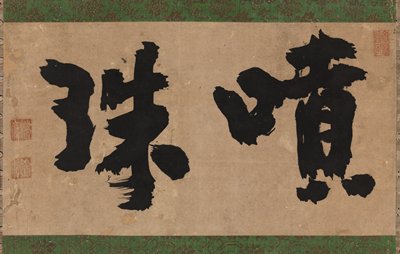
Sophisticated Eloquence (Funju 噴珠)
- Medium
- Hanging scroll, ink on paper
- Dimensions
- 8 3/4 × 16 3/16 in. (22.23 × 41.12 cm) (image) 40 3/8 × 17 7/8 in. (102.55 × 45.4 cm) (mount, without roller)
- Genre
- Calligraphy
Tags
Japan
About
Three generations of tea masters in the late 1400s and 1500s are credited with transforming the Japanese tea ceremony and developing the form of tea preparation known as wabi-cha, based on the notion of rustic simplicity: Murata Jukō (1423–1502), Takeno Jōō (1502–1555), and his follower Sen no Rikyū (1522–1591). Instead of using only luxurious Chinese tea utensils as had been the practice, these three men preferred rougher Japanese ceramic utensils or even those handmade from bamboo. They also sought the calligraphy of Zen monks, known as bokuseki (ink traces), to hang in the alcove of the tearoom. The words on such a scroll might offer an opportunity for contemplation or may set the scene of an entire gathering. This scroll includes only two characters that mean “sophisticated eloquence.” The artist, Seigan Sōi, was a Zen monk and abbot of Daitokuji, an enormous Zen monastic complex in the heart of Kyoto.