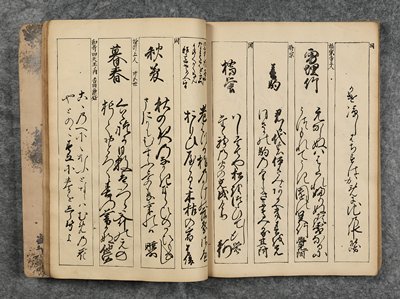
Mirror of Hands of Ancient Calligraphy (Kohitsu tekagami)
Tō Rian
1651
- Medium
- Woodblock printed book, ink and color on paper
- Dimensions
- 15 5/16 × 11 1/2 × 1 3/8 in. (38.89 × 29.21 × 3.49 cm)
- Genre
- Books & publications
Tags
Japan
About
In Japanese society, poetry was important not just for the beauty of its sound, but also for the beauty of its written form. Mirror of Hands is an example of a tekagami (“mirror of hands”); it is a collection of 136 fragments (kire) and 616 strips (tanzaku) written by different hands, all reproduced in print. The colophon, which provides information about the circumstances of publication, notes that the recorded works have been authenticated by an expert, and modern scholars have noted that some extant pieces look remarkably similar to the copy in the book. A woodblock-printed tekagami allowed people who could not afford to buy coveted pieces by the most famous calligraphers a means to appreciate and study their hands.