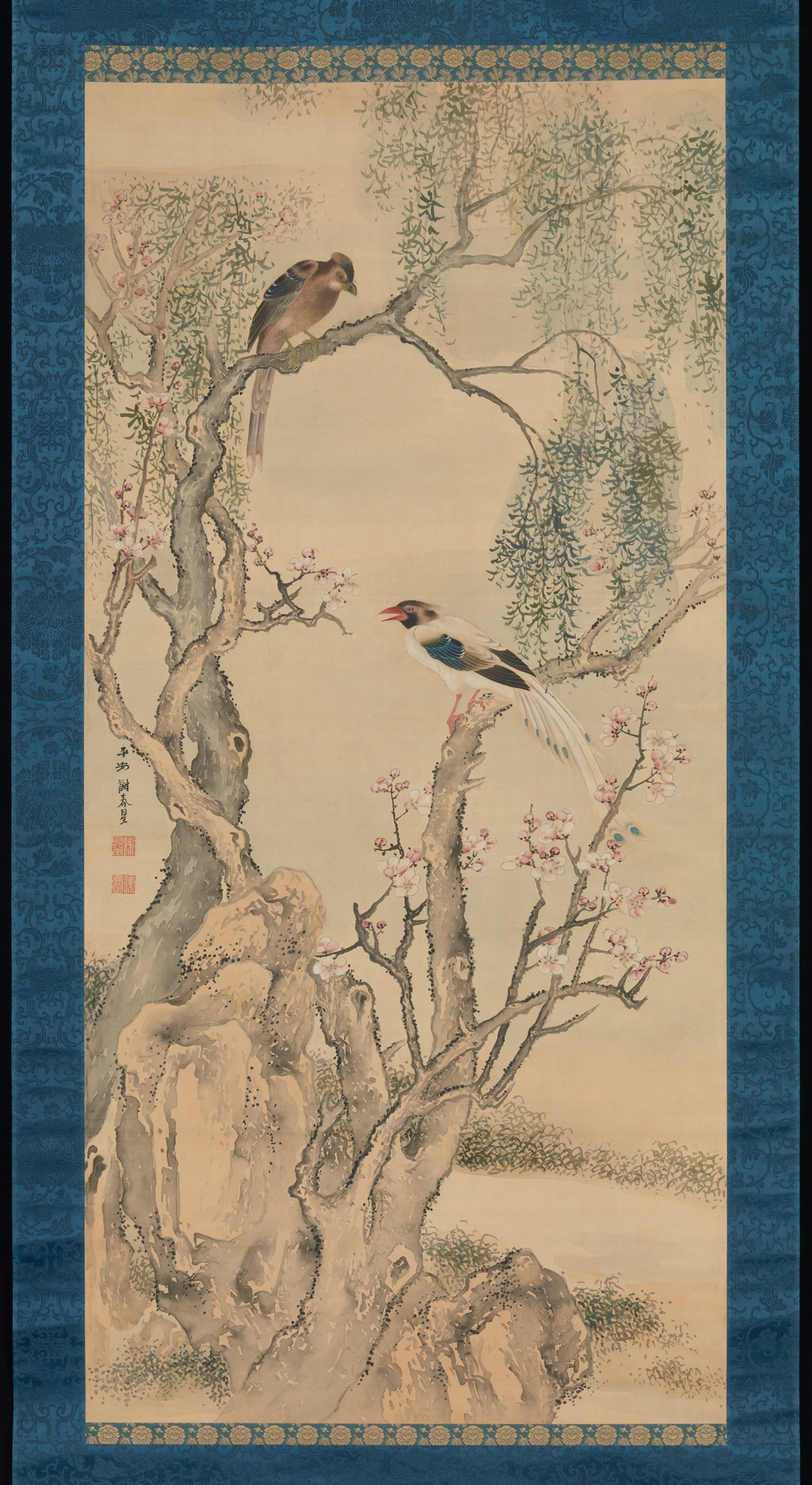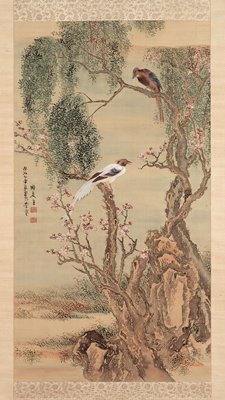
Two Magpies on Willow and Peach Trees
Yosa Buson
1774
- Medium
- Hanging scroll, ink and color on silk
- Dimensions
- 50 11/16 × 27 9/16 in. (128.75 × 70.01 cm) (image)
- Genre
- Paintings
Tags
Japan
About
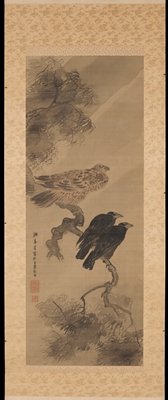
In China, willows and peach trees are likened to a pair of lovers, and here their branches are intertwined. A pair of magpies, known to bring wealth and have divine power, sit in the trees with the female above seeming to look down critically at her partner’s singing. Yosa Buson, a poet and prolific painter, drew from a variety of sources for his paintings. The inspiration for this large work is unmistakably Shen Nanpin (also known as Shen Quan, c. 1682–1760), an older Chinese contemporary of Buson’s who lived and worked in the Japanese city of Nagasaki briefly during the early 1730s and attracted many Japanese followers. Shen’s colorful, realistic pictures of birds and flowers proved extremely popular in Japan in the mid-1700s, and he continued to send works back to Japan even after his return to China in 1733.