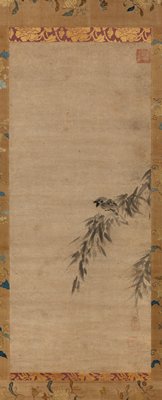
Sparrow on Bamboo in the Rain
- Medium
- Hanging scroll, ink on paper
- Dimensions
- 28 3/16 × 12 in. (71.6 × 30.48 cm) (image) 70 7/8 × 17 in. (180.02 × 43.18 cm) (mount, without roller)
- Genre
- Paintings
Tags
Japan
About
This simple painting of a single sparrow resting on a shoot of bamboo in the rain was treasured in Japan for more than five hundred years. Over time, it accumulated numerous storage boxes, wrappings, and documents. In this gallery, you can explore the painting and its history through these accumulated objects. In medieval Japan, the Zen monk-painter Muqi Fachang (c. 1210–after 1269) was the most beloved of all Chinese artists. Japanese Zen monks visiting China met or heard of Muqi, acquired his paintings, and brought them back home to Japan. Within a few decades, the foremost Japanese art collections all contained paintings purported to be by Muqi, although many of them were probably not by Muqi himself. But this did not seem to matter. In Japan, “Muqi pictures”—some by Muqi, others in his style—were in high demand as luxury items, and numerous Japanese painters mastered Muqi-style painting and Muqi-specific subject matter. “Muqi pictures” like this one were also sought after for display during tea ceremonies. One of the most famous of these “Muqi pictures” showed sparrows huddled together on a bamboo shoot during rain. That painting made its way into medieval Japan’s most famous collection of Chinese art—that of the Ashikaga shoguns (Japan’s military leaders). It undoubtedly inspired this image of a sparrow on bamboo. Although it was not painted by Muqi himself, it was treasured for generations as a “Muqi picture, ” as evidenced by its many boxes, wrappers, and documents, all displayed here.