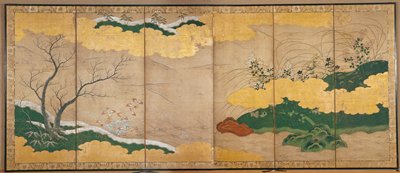
Mountain Landscape in Autumn and Winter
- Medium
- Six-panel folding screen, ink, color, and gold on paper
- Dimensions
- 58 9/16 × 135 5/8 in. (148.75 × 344.49 cm) (image) 65 3/4 × 142 3/4 × 3/8 in. (167.01 × 362.59 × 0.95 cm) (outer frame)
- Genre
- Paintings
Tags
Japan
About
This work—which would have been paired with a right-hand screen depicting spring and summer—is representative of folding screens painted from about 1500–1550 depicting Japanese landscapes of the four seasons in the so-called yamato-e (“Japanese painting”) style, in contrast to the Chinese-style ink paintings of nonnative scenery that were also prevalent at this time. This left-hand screen depicts a stream that meanders through the foreground from right to left, past a hill crowned by a profusion of autumn grasses—Eulalia grass, bellflower, bush clover, Patrinia—and toward another promontory, this one laden with snow and capped by a barren tree, bamboo grass, and Ardisia. A few faint lines indicate a patchwork of harvested rice fields in the middle ground. Farthest back are mountains topped with trees and snow, visually separated from the rest of the image by a bank of golden clouds.