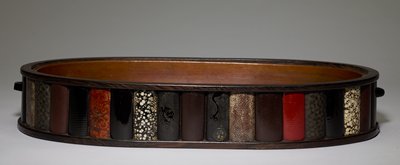
Bonsai or flower basin made of forty scabbard pieces
- Medium
- Wood, lacquer, copper and other metals, abalone, lizard skin, shark skin
- Dimensions
- 3 3/4 × 24 3/16 × 13 1/16 in. (9.53 × 61.44 × 33.18 cm)
Tags
Japan
About
Forty sections of several antique sword scabbards (saya) were set about the circumference of this basin (suiban) made for flower arrangements or bonsai display. A removable copper basin was inserted in a wood base with surrounding belts of tiger-striped, ebony-like hardwood. Between these belts are alternating sections of 19 scabbards made of different material and the handles on each end are the actual knobs (kurigata) to attach a braided cord (sageo) to the scabbard. On some, utility knife (kozuka) openings are clearly visible. Starting from one of the handles, the different scabbard pieces are: plain black lacquer (kuro rōiro-nuri), glossy-brown insect-eaten lacquer (cha-urumi mushikui-nuri), glossy-brown stone surface lacquer (cha-urumi ishimeji-nuri), black burnished shark skin lacquer (kuro samegawa togidashi), unknown type using crushed abalone shell, lacquer in thin parallel lines (ichibu kizami urushi-nuri), brown burnished shark skin lacquer (samegawa togidashi), lacquer with crushed abalone shell and flower pattern (hanamon aogai miji-nuri), rare shark skin on the back (kairagi same), wrapped brocade (nishiki tsutsumi), black insect-eaten lacquer with auspicious clouds (zuiunmon kuro urushi mushikui-nuri), sandalwood imitating lacquer (byakudan-nuri), imported rare lizard skin, lacquer with crushed abalone shell (aogi miin-nuri), strip motif lacquer (shuroke fuemaki-nuri), pronounced insect-eaten) lacquer (mushikui-nuri), and red lacquer with willow pattern (shu-urushi yanagimon nuri).
![Netsuke [Dog and Jar]](https://1.api.artsmia.org/31746.jpg)