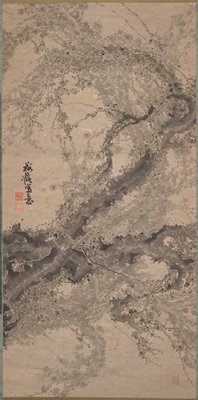
Plum Drawn from the Mind
- Medium
- Hanging scroll, ink on paper
- Dimensions
- 53 3/16 × 26 1/16 in. (135.1 × 66.2 cm) (image) 83 3/8 × 27 1/2 in. (211.77 × 69.85 cm) (without roller)
- Genre
- Paintings
Tags
Japan
About
The practice of painting blossoming plum branches in monochrome ink seems to have emerged in 10th-century China, and it became popular among the Japanese literati of the 18th and 19th centuries. Delicate flowers budding from a wizened plum tree in winter carried associations of longevity, renewal, and purity. The inscription, shai, meaning “drawn from the mind, ” is the opposite of shasei, or “sketched from life”; indeed, this is a particularly free-spirited and imaginative interpretation of this subject. A variety of tones of ink applied in impressionistic splotches with a wet brush convey the vital splendor of a plum tree breaking into a profusion of blossoms on the cusp of spring. Baichi was a priest of the Pure Land, or Jōdo, school of Buddhism and was known for his poetry, calligraphy, and paintings of landscapes and flora.