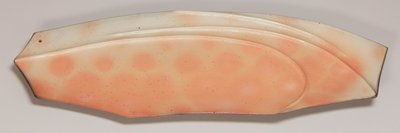
Long En'yōsai Plate
Matsuo Jun
2002
- Medium
- Stoneware with salt glaze
- Dimensions
- 1 11/16 × 10 1/16 × 27 3/4 in. (4.29 × 25.56 × 70.49 cm)
- Genre
- Ceramics
Tags
Japan
About
Matsuo Jun successfully adapts the tradition of salt glaze pottery, introduced to Japan in the mid-20th century, imparting a lusterous surface to his dynamic forms. He heats his kiln to over 1, 900 degrees Fahrenheit (1, 050 degrees Celsius) and inserts 55 pounds (25 kg) of salt in a series of 10 applications, each time creating a steam of salt that evaporates in the kiln and reacts with the silicate content in the clay. Differences in the clay, length of firing, and the position of the work in the kiln contribute to the coloration of the final work. The artist has dubbed the effect “en'yōsai, ” literally “salt kiln color.”