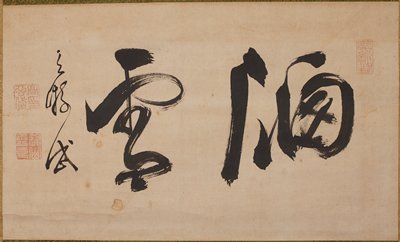
Window Snow
- Medium
- Hanging scroll, ink on paper
- Dimensions
- 11 3/8 × 19 1/16 in. (28.89 × 48.42 cm) (image)
- Genre
- Calligraphy
Tags
Japan
About
Kō Gentai’s father was a Chinese administrator who had left Japan after fathering a child there. Gentai spent ten years as a young man searching unsuccessfully for his father in China and then returned to Japan to become an interpreter. He studied medicine and became a health expert, serving the shogun in Edo (today’s Tokyo) from 1709–1721. Gentai was known for his cursive script. This calligraphy shows two characters of stark contrast. For “window” on the right Gentai used the character 牕 instead of 窗 or 窓 which is the variation in use today. He simply omitted the radical 心 at bottom right of 牕 and constructed the remaining elements primarily of straight and rectangular lines. “Snow” on the left is usually written with eleven strokes but here Gentai rendered it very fluid with only four. 牕雪 Window Snow