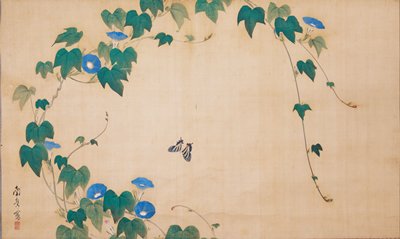
Morning Glory
- Medium
- Hanging scroll, ink and color on paper
- Dimensions
- 24 5/16 × 40 9/16 in. (61.75 × 103.03 cm) (image) 47 9/16 × 46 7/8 in. (120.81 × 119.06 cm) (mount, without roller)
- Genre
- Paintings
Tags
Japan
About
In Japan, morning glories are called asagao, or “face of the morning, ” in reference to the fleeting beauty of a woman’s face in the morning. The plant was originally brought to Japan from China as medicine, but the beauty of their blooms soon captivated aristocrats, who wrote poems about the flower. In the 1800s, morning glories became popular among casual and professional gardeners who actively bred them for natural mutations. Watanabe Nangaku studied painting under Maruyama Ōkyo, who was interested in the study of and depiction of nature. Here, he shows the morning glory from shifting angles and the subtle differences in color of the vines.