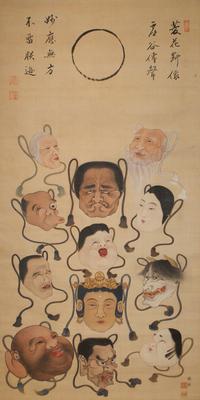
Noh and Kyogen Masks
- Medium
- Hanging scroll, ink on silk
- Dimensions
- 55 1/4 × 27 13/16 in. (140.34 × 70.64 cm) (image) 79 × 32 15/16 in. (200.66 × 83.66 cm) (mount, without roller)
Tags
Japan
About
Twelve floating heads run the gamut of emotions in this hanging scroll. The heads are masks, as signaled by the corded ties extending from the ears or sides of the heads. Some of the masks depict supernatural subjects, such as the fierce demon with fangs and horns at the right, the serene bodhisattva second from the bottom in the center column, and the large bulbous head of the laughing god of happiness, Hotei (Ch. Budai) at the bottom left. The inscription along the top is an excerpt from The Record of Linji, a collection of the words and deeds of Linji Yixuan (died 866), the founder of Chan (Jp. Zen) Buddhism. Zeami Motokiyo, who with his father Kan’ami Kiyotsugu developed the current form of Noh theater, often incorporated Zen Buddhist themes into his plays. The excerpt from The Record of Linji might be a reference to this connection between Zen and Noh. 菱花対像 虚谷伝声 妙応無方 不留朕跡 A mirror confronting a form, an empty valley echoing a sound. Marvelously responding in any direction, he left not a trace behind. (Trans. Ruth Fuller Sasaki)