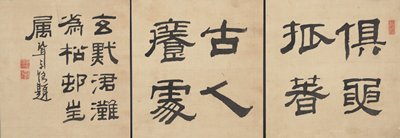
![Bamboo and Chinese Poems [left of a pair]](https://1.api.artsmia.org/118363.jpg)
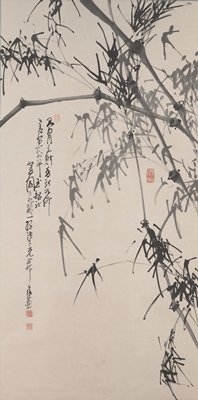
Bamboo and Chinese Poems [left of a pair]
Doi Gōga
1865
- Medium
- Six-panel folding screen, one of a pair, ink on paper
- Dimensions
- 52 1/4 × 125 5/8 in. (132.72 × 319.09 cm) (image) 67 5/16 × 139 3/16 × 5/8 in. (170.97 × 353.54 × 1.59 cm) (mount)
Tags
Japan
About
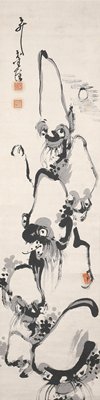
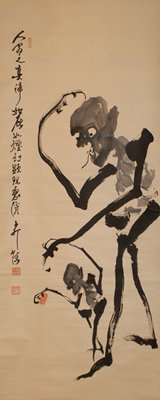
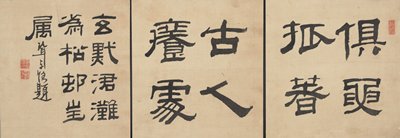
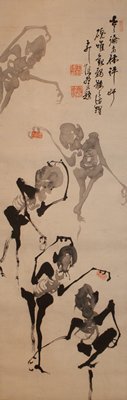
Scholar and painter Doi had a conventional side and an eccentric side. The latter is evident in the painting of prancing skeletons in the nearby gallery; the former in this pair of screens. Doi alternated panels of pure calligraphy with those depicting bamboo with poetic accompaniment. Citing poems from the Tang (618–907 ce) and Song (960–1279 ce) dynasties, Doi puts his knowledge of classical Chinese poetry on display. Bamboo was considered one of the fundamental forms of painting in the Chinese style, and their pairing with Chinese poetry further highlights Doi’s erudition. Left screen, poems on panels from right to left: 報答春光知有處,應須美酒送生涯。 I know where to go to appreciate the springtime, fine wine is needed to bid farewell to my years Du Fu, “Seven-Character Poem on Seeking Flowers Alone by the Riverside” (Tang Dynasty) 閒眠盡日無人到,自有春風為掃門 Idly napping for the whole day with no visitors, spring wind sweeps my door Wang Anshi, “Among the Bamboo” (Song Dynasty) 日斜回首江頭望,一片晴雲落後山 Looking back along the riverbank in the setting sun, a band of clear cloud descends on the rear mountains Tang Qiu, “For Changle Temple” (Tang Dynasty) 問余何意棲碧山,笑而不答心自閒。 Asking me why I reside in the Green Mountain, I smile quietly with an idiosyncratic heart Li Bai, “Questions and Responses in the Mountains” (Tang Dynasty) Right screen, poems on panels from right to left: 凍蕊凝香色艷新,小山深塢伴幽人。 Frozen pistils, condensed fragrance and brilliant colors, a small hill and deep basin accompany lonely visitors Lu Xisheng, “Plum Blossom Basin. Frozen Pistils, Solidified Fragrance and Brilliant Colors” (Tang Dynasty) 自恨尋芳到已遲,往年曾見未開時。 I resent that I was late when finding the flower [my love]; I once witnessed the budding flower in the past Du Mu, “Poem of Sorrow Farewell” (Tang Dynasty) 仙中姑射接瑤姬,成陣清香擁路岐。 Divine Yeshe [a nymph] makes contact with Lady Yao, the roads are full of waves of clear fragrance Wang Zhou, “Plum Blossom in the Post Station of Dashi Ridge” (Northern Song) 待同[只應]更使伶倫見,寫盡雌雄雙鳳鳴。 Wait to let Linglun [a legendary creator of music] see this; exhaust ink to portray the singing of dual [male and female] phoenixes Liu Zongyuan “Bamboo Grove of Qingshui Post Station” (Tang Dynasty)
![Bamboo and Chinese Poems [right of a pair]](https://1.api.artsmia.org/118364.jpg)