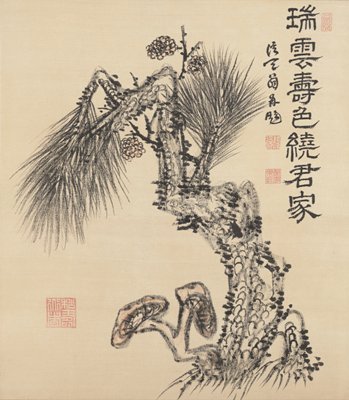
Pine and Poem Gifts
- Medium
- Hanging scroll, ink and color on crepe paper
- Dimensions
- 24 1/4 × 23 7/8 in. (61.6 × 60.64 cm) (image, image 1) 28 1/4 × 24 11/16 in. (71.76 × 62.71 cm) (image, image 2) 78 × 30 9/16 in. (198.12 × 77.63 cm) (mount, without roller)
Tags
Japan
About
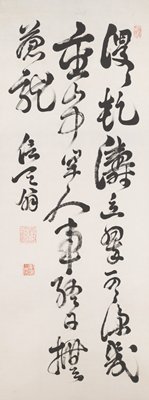
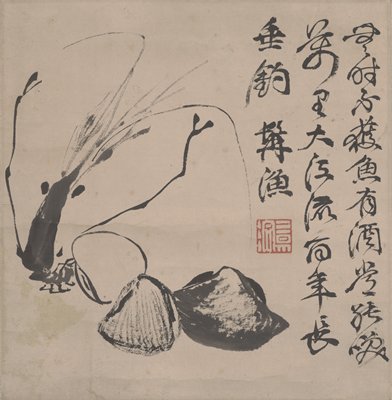
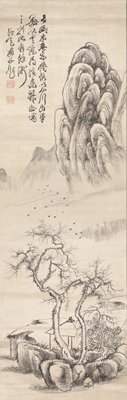
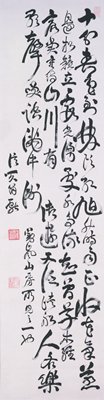
A gnarled pine tree curves as if stretching its few pine cone-bearing branches, while lingzhi (Jp. reishi) mushrooms grow from its base. In East Asia, both pines and lingzhi mushrooms were considered auspicious symbols. Pines stood for longevity, constancy, and virtuousness, while lingzhi mushrooms signified immortality. Yamanaka likely created this work without a specific person in mind, as the inscription to the right offers a general wish of prosperity. The poem above further wishes felicity upon the recipient with mentions of various symbols of good even while working, he continued to cultivate his interest in Chinese culture, art, and calligraphy. Upper panel: 萬里天開積水明雲 霞涌處是蓬瀛釆 芝人倚長松立皓 鶴聲中紅旭生 信天翁 Ten thousand miles of sky open over the brilliance of accumulated waters, Where clouds and mist boil up is the isle of the immortals [Mount Penglai]; While a man gathering divine mushroom leans on a tall pine, White cranes sing in the rising red sun. Lower panel: 瑞雲壽色繞君家 信天翁画題 [May] the auspicious clouds in the color of longevity surround your household. Painted and inscribed by Shinten'ō. (Trans. adapted from Stephen Addiss)
![Rock [left of a pair of Pine and Rock]](https://1.api.artsmia.org/117427.jpg)

![Pine [right of a pair of Pine and Rock]](https://1.api.artsmia.org/117426.jpg)