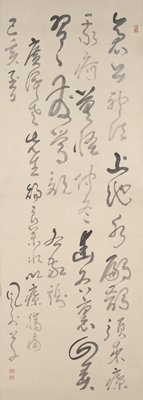
Taiga-style Calligraphy
Fūgai Honkō
1839
- Medium
- Hanging scroll, ink on paper
- Dimensions
- 44 7/8 × 16 1/16 in. (113.98 × 40.8 cm) (image) 69 3/4 × 20 15/16 in. (177.17 × 53.18 cm) (mount, without roller)
- Genre
- Calligraphy
Tags
Japan
About
Fūgai playfully experimented with tonality, size, and writing in this work. One can see the ink running out, and the brush being dipped into ink through the change in ink tones. Taking advantage of the looseness of structure of the running-cursive script, he varies the size of each character as well, elongating some characters while flattening others, thus creating a visual rhythm in addition to the poetic rhymes. Fūgai gained the nickname “octopus Fūgai” because of his signature, seen at the bottom left beginning with an arched line and a squiggle coming out of it, which resembles the creature. He was a Sōtō sect Zen monk but was well-known for his painting and calligraphy. 念公神法上池水 扁鵲須來療 我疴 莫怪仲冬幽谷裡 山靈 習習發鶯歌 廣澤老先生賜良藥水以療傷痛 Reminiscing that you divinely summoned [for me] the “upper-pond” water to drink, Bian Que has come to cure me of my illness! Do not blame mid-winter here in this hidden valley The Mountain Spirit conjures in profusion the songs of orioles! Mr. Hirosawa bestowed me fine medicinal water to cure my illness (Trans. adapted from Stephen Addiss)