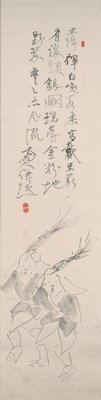
Temporary Palace at Yoshino
- Medium
- Hanging scroll, ink on paper
- Dimensions
- 43 3/4 × 11 5/16 in. (111.13 × 28.73 cm) (image) 68 3/4 × 16 7/16 in. (174.63 × 41.75 cm) (mount, without roller)
- Genre
- Calligraphy
Tags
Japan
About
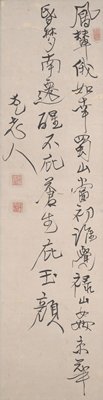
Angular, thin, and unconventional, the brushwork here may appear unsteady and unskilled, but is in fact Murase’s carefully crafted signature writing style. He was an accomplished poet, calligrapher, and painter, and studied Chinese literature and philosophy. This poem is an example of qiyan jueju poetry, which is a quatrain of seven characters each in length with two pairs of couplets. In this poem, Murase draws upon his knowledge of Chinese history to compose a poem about the collapse of the once-mighty Tang dynasty (618-907 ce) due to Emperor Xuanzong’s obsession with Yang Guifei, his favorite concubine and one of the four great beauties of ancient China. 鳳輦俄如幸蜀山當初誰覺安祿姦京華 昏夢南遷醒不庇蒼生庇玉顏 The Imperial carriage travels like Emperor Ming [of Tang dynasty]’s flight to the Shu Mountains [modern Sichuan Province]; At first, who could have known the wickedness of Anlu? Life in the capital was like a dream waken up by the move to the south; He had not protected the people, but only the one with the jade face [elegant woman]. (Trans. adapted from Stephen Addiss)