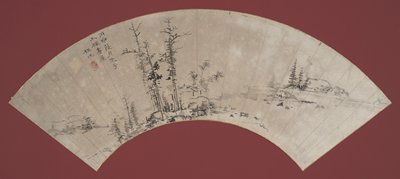
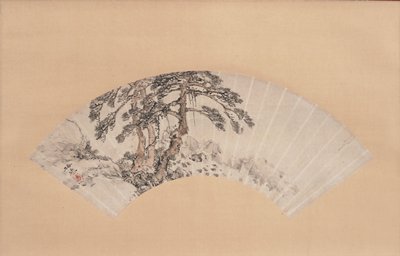
Landscape in the Manner of Ni Zan
Yamamoto Baiitsu
1836
- Medium
- Fan, ink on paper
- Dimensions
- 8 1/4 × 19 1/2 in. (20.96 × 49.53 cm) (sheet, fan) 12 1/2 × 22 in. (31.75 × 55.88 cm) (mount)
- Genre
- Paintings
Tags
Japan
About
Copying old paintings and emulating ancient masters is a practice seen frequently in works by Japanese literati painters. One of the leading painters of his day, Yamamoto Baiitsu turned for inspiration to Ni Zan, a Chinese painter who lived 500 years earlier. Ni Zan was known for his distinctively sparse landscapes, which he created using sketchy brushwork and a relatively dry brush. His compositions often feature a foreground of lanky trees separated from far-distant mountains by a wide expanse of undefined water. Baiitsu skillfully adapted Ni Zan’s compositional formula to the folding-fan format by placing the foreground slightly left of center and then creating two separate mountain vistas, one at far left and the other at right.

![Three Friends of Winter [left of a pair]](https://1.api.artsmia.org/118219.jpg)
![Fall [right of a pair of Flowers and Insects of Spring and Fall]](https://1.api.artsmia.org/82208.jpg)