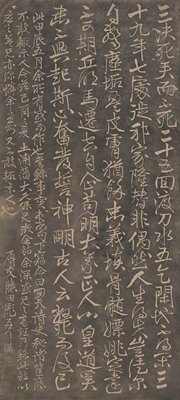
Poem of 1849
Fujita Tōko
1849
- Medium
- Hanging scroll, ink on paper
- Dimensions
- 50 7/8 × 22 15/16 in. (129.22 × 58.26 cm) (image) 73 3/8 × 24 7/16 in. (186.37 × 62.07 cm) (mount, without roller)
- Genre
- Calligraphy
Tags
Japan
About
This work is a rubbing, an impression of inscriptions carved into stone made by placing a sheet of moistened paper over the surface and tapping with a ball of cloth soaked in ink. For centuries, rubbings played an important role in transmitting calligraphy because it allowed for accurate reproductions of not just the content but also the writing style. This work preserves a poem by Fujita Tōko, a Confucian scholar. Fujita was exiled in 1844 when his lord Tokugawa Nariaki was forced into retirement. In the poem, Fujita expressed his devotion to the cause of restoring power to the Emperor, a sentiment that ultimately grew among samurai and led to the Meiji Restoration. 三決死矣而不死,二十五回渡刀水。 五乞閒地不得閒,三十九年七處徙。 邦家隆替非偶然,人生得失豈徒爾。 自驚塵垢盈皮膚,猶余忠義填骨髓。 嫖姚定遠不可期,丘明馬遷空自企。 苟明大義正人心,皇道奚患不興起。 斯心奮發誓神明,古人有雲斃而已。 Three times [I was] prepared to die, but did not. Twenty-five times [I] crossed Tōsui [Tone River]. Five times, [I] sought a quiet place [to retire] but did not obtain carefreeness. In thirty-nine years I moved to seven places. The rise and decline of a state is not by chance. How could the achievements and disappointments of life be trivial? The dust and filth that covers [my] skin surprises me. The loyalty and justice that still remains fills my whole bone and marrow. Do not expect Piao Yao* and Ding Yuan** Vainly plan by myself like Qiuming*** and Maqian**** If [I can] reveal the great cause and rectify the human spirit There is no worry that the way of the Emperor will not begin again. This spirit is stirred; I pledge to the gods. As the ancients say: [I am determined to fight] until my dying day. *Huo Qubing (140 bc–117 bce), Chinese general **Ban Chao (32–102 ce), Chinese general ***Zuo Qiuming (556–451 bce), Chinese historian who wrote The Commentary of Zuo (Zuo Zhuan) ****Sima Qian (c. 145–c. 86 bce), Chinese historian who wrote the Records of the Grand Historian (Shiji)