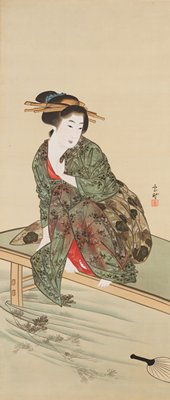
![City Girl [left of a triptych of Three Beauties]](https://1.api.artsmia.org/117172.jpg)
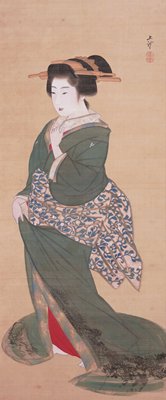
City Girl [left of a triptych of Three Beauties]
Mihata Jôryû
1830
- Medium
- Hanging scroll, left of a triptych, ink and color on silk
- Dimensions
- 10 7/16 × 11 7/16 in. (26.51 × 29.05 cm) (image) 55 3/8 × 25 5/16 in. (140.65 × 64.29 cm) (mount, without roller)
- Genre
- Paintings
Tags
Japan
About
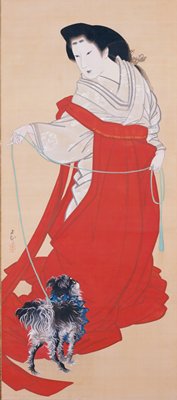
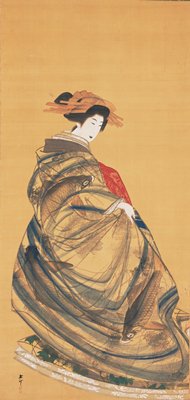
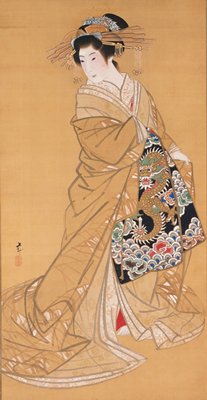
Although they are unsigned, these three paintings exhibit the idiosyncratic style of artist Mihata Jōryū’s beauties. At first glance their faces look similar, but Jōryū juxtaposes three types of femininity—a prostitute holding folded tissue paper, a geisha (entertainer) with a fan, and a city girl. Each one represents a different type of charm through her gesture and expression. Mihata Jōryū was active in Kyoto during the 1830s, and his paintings of beauties with clear-cut features and luxuriously designed kimonos became very fashionable, even in Edo (present-day Tokyo). By the 1830s many artists had come to follow Jōryū’s style, but little is known about the artist himself. Even his name is somewhat unclear, because he uses seals that read “Jōryū” and others reading “Jōryō.” His family name is believed to be Mihata, but that also is uncertain, for he used the surname Yokoyama on at least one extant painting.
![Geisha [right of a triptych of Three Beauties]](https://1.api.artsmia.org/117170.jpg)
![Peeking Boy [right of the pair Kyoto Maiden and Peeking Boy]](https://1.api.artsmia.org/116865.jpg)

![Courtesan [center of a triptych of Three Beauties]](https://1.api.artsmia.org/117171.jpg)