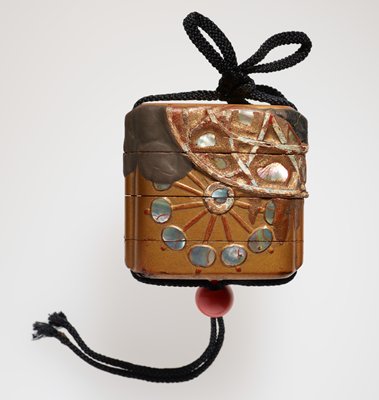
Wide three-case inro showing plovers in flight above waves, stone basket and water wheel
- Medium
- Lacquer (kinji, takamaki-e), gold, silver, raden, ojime, silk cord
- Dimensions
- 2 5/16 × 2 1/2 × 7/8 in. (5.87 × 6.35 × 2.22 cm)
- Genre
- Accessories
Tags
Japan
About
A number of different motifs are fit onto this compact four case inrō, beginning with a “plover over waves” design in the style of the Rinpa artist, Ogata Kōrin (1658–1716). The plovers are executed in chunky mother-of-pearl inlays and takamaki-e, and fly over mountainous waves that simulates the look of pewter sheeting—an element favored by Kōrin and his predecessor, Hon’ami Kōetsu (1558–1637). Oversized inlays are used for the depiction of the water wheel and rock basket as well, creating an artfully cluttered composition. The imagery of plovers over waves is a common Japanese literary convention, which seems to have first appeared in the Kojiki, an 8th-century compendium of Japanese origin myths. The scene generally connotes the struggle to surmount the difficulties of life.