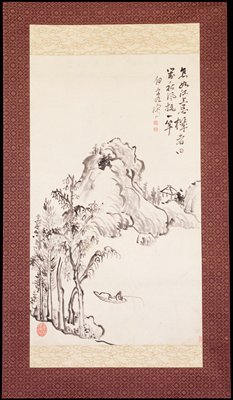
No Amida in the South
- Medium
- Hanging scroll, ink on paper
- Dimensions
- 49 3/16 × 8 in. (124.94 × 20.32 cm) (image) 74 1/2 × 10 in. (189.23 × 25.4 cm) (mount, without roller)
- Genre
- Calligraphy
Tags
Japan
About
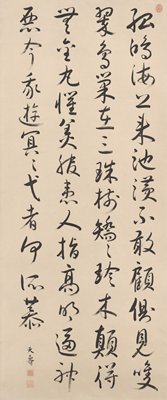
A skeptic of Buddhism, Kan humorously plays with the literal interpretation on the phonetic translation of a Sanskrit Buddhist chant, namu amida butsu (“I take refuge in Amitābha Buddha”) to indicate his doubts about this religion. He writes that as the Amitābha Buddha is neither in the North nor the South, Buddhism is a practice in vain. Kan’s cursive brush visibly thins out starting from “No Amida in the north;” we might ascribe this physical fading to his mild uncertainty and caution for altering the standard chant. Accompanying Tenju’s criticism of Buddhism in the final two clauses, his writing also suddenly becomes visibly looser and less inhibited. 南無阿彌佛 北無阿彌佛 南北維過 去 畢竟無這物 No Amida in the south No Amida in the north; South and North certainly exist But there is no such thing [as Buddha] Original chant: 南無阿弥陀仏 I take refuge in Amitābha Buddha