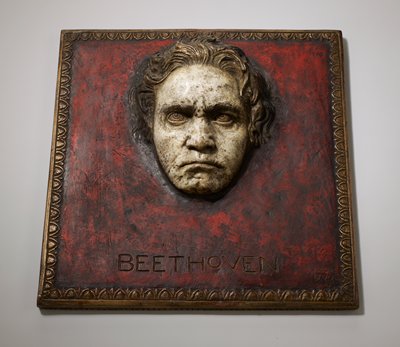
Portrait of Beethoven
Franz Stuck
1902
- Medium
- Parcel gilt and polychromed stucco
- Dimensions
- 18 15/16 x 18 7/8 x 5 3/16 in. (48.1 x 47.94 x 13.18 cm)
- Genre
- Sculpture
Tags
Germany
About
Beethoven-mania resulted in the production of a number of outstanding paintings and sculptures around the turn of the 20th century. Franz von Stuck’s high relief Beethoven, which shows the composer’s pale face emerging from a red color field, is among the most original and unsettling. In his Beethoven relief, Stuck strove to create a visual equivalent for Beethoven’s music and his character. He particularly emphasized the composer’s powerful and violent character, which is expressed in Beethoven’s most admired works, such as the Third, Fifth, and Ninth Symphonies. Through the sitter’s seemingly angry physiognomy (which is based upon Franz Klein’s life cast of the composer’s face taken in 1812, of which Stuck owned a copy), and through a choice of two strong, intense colors, which are traditionally associated with passion and death, Stuck evokes the emotional depth and impact of Beethoven’s music. Beethoven’s likeness is heroicized and demonized at the same time – anticipating in many ways Anthony Burgess’s exploration of the relationship of Beethoven’s music and violence in A Clockwork Orange (1962), and Stanley Kubrick’s cinematographic interpretation of the novel released in 1971. Stuck’s Beethoven is a primary example of this artist’s work. A highly influential exponent of symbolist fin-de-siècle painting, Stuck co-founded the Munich Secession. Trained and successful as a painter, Stuck became strongly interested in sculpture and design starting in the 1890s. The decision to take up sculpture was centered on two overarching preoccupations of the era: the exploration of polychrome sculpture, which was first kindled by the discovery that ancient Greek and Roman sculptures were originally painted; and the impetus to create a ‘total work of art’ (‘gesamtkunstwerk’) encompassing architecture, sculpture, painting, and in some instances, exploring ways to include even poetry or music. This latter concept – which from the musical vantage point was especially promoted by Richard Wagner – was certainly fundamental for Stuck’s artist home and studio, which he built in Munich from 1897. The idea to include music into the visual gesamtkunstwerk is crucial for the understanding of Stuck’s Beethoven relief, since it not only fuses painting and sculpture, but attempts to find a visual equivalent for the sitter’s music. It is particularly appropriate that Beethoven – who was perceived as a pioneer of Romanticism by his devotees – is portrayed here by employing artistic (voluntary) synaesthesia (the cross-stimulation of senses), which was a device of fundamental importance in romanticist poetology.


![[Portrait of an Unknown Woman]](https://media.getty.edu/iiif/image/82d4c992-9c14-4955-893b-61cae10ca20c/full/843,/0/default.jpg)
