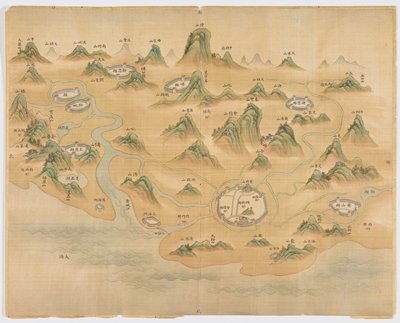
Maps of Eleven Prefectural Cities in Zhejiang Province
- Medium
- Ink and color on silk
- Dimensions
- 1 1/4 x 9 1/4 x 13 7/8 in. (3.18 x 23.5 x 35.24 cm) (cover, closed) 13 7/16 x 8 7/16 in. (34.13 x 21.43 cm) (object part, each leaf, as folded, approx.)
- Genre
- Paintings
Tags
China
About
Map making has a long history in China. There are two parallel traditions of Chinese cartography: one mathematical, the other descriptive. The mathematical form is concerned with measurement and is therefore considered a science; the descriptive form is focused on depiction with less concern for accuracy. The maps in this set, of 11 prefectural cities in Zhejiang province, are examples of descriptive cartography. In representing hills, rivers, and buildings, the mapmakers rendered the topography in a manner suggestive of landscape painting. But, unlike in that art form, here these elements are labeled.