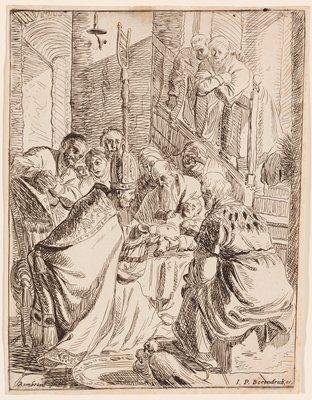
Circumcision of Christ
- Medium
- Etching
- Dimensions
- 8 3/8 x 6 5/16 in. (21.27 x 16.03 cm) (plate) 8 9/16 x 6 1/2 in. (21.75 x 16.51 cm) (sheet)
- Genre
Tags
netherlands
About
The Circumcision of Christ is Rembrandt's starting point as an etcher, not a masterpiece, but a signpost marking the beginning of a restless, searching career. In 1626, shortly after completion of his final apprenticeship, Rembrandt appears to have visited the workshop of Haarlem publisher Jan Pietersz Berendrecht, who had a habit of encouraging young artists to try their hands at printmaking. Under the guidance of experienced craftsmen, the young artist took up a needle and scratched his design into the yielding film. Rembrandt drew with remarkable speed and seems to have relished working with an instrument than functioned like a magic pen that never ran out of ink. Close observation of the print reveals engraved additions that give the image a far more finished appearance than the etching alone. A skilled craftsman has retouched weak, under-bitten lines and added a borderline as well as the inscriptions identifying the artist and the publisher. The Circumcision is the only instance of a publisher's address on any of Rembrandt's early prints; moreover, it is his only early print with the engraved finishing touches. This etching is more common than Rembrandt's other early prints, and it demonstrates closer attention to preparation of the plate than we find in the others. Such evidence suggests that Rembrandt returned to Leiden and set himself the task of understanding and duplicating some of the procedures that he saw in Berendrecht's workshop. Clearly he flailed about for a while, but one he hit his stride, he was unstoppable.