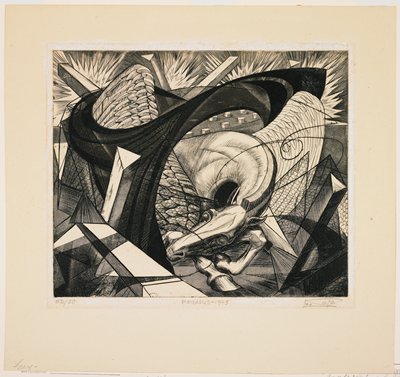
Pegasus
Leo Katz
1945
- Medium
- Engraving, etching, and soft-ground etching
- Dimensions
- 9 7/8 x 11 7/8 in. (25.08 x 30.16 cm) (plate) 10 5/8 x 12 5/16 in. (26.99 x 31.27 cm) (sight) 25 x 20 3/4 in. (63.5 x 52.71 cm) (outer frame)
- Genre
Tags
United States
About
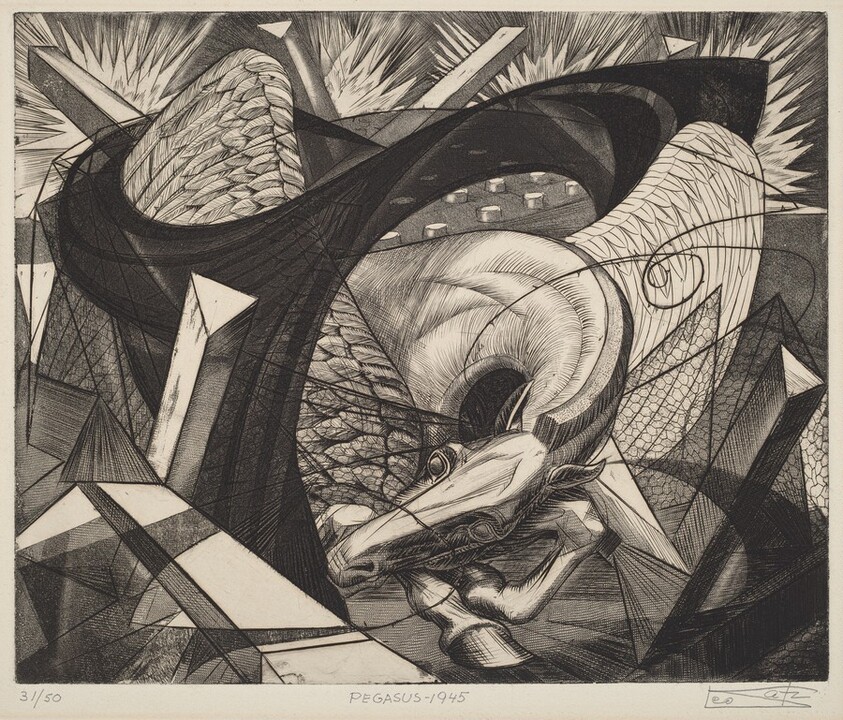
Created at the close of World War II, Katz's dramatic vision of the mythical winged horse Pegasus struggling to free itself from barbed wire and nets among concrete tank traps is a powerful metaphor for the condition of the human spirit in the aftermath of war. Traditionally seen as a symbol of creative imagination, Pegasus is here shown in the midst of a rebirth, a spiritual awakening suggested by the dark pelvic-like form that arches over the horse's back and wings. Katz wrote: I had the feeling, at the time (1945) that the great question of our era is, whether this birth, or rebirth, of Pegasus will be a living and lasting success or not. It is not enough to have rockets and bombers flying high in the air while man's creative soul with its dreams is permanently grounded. Katz was most active as a printmaker in the 1930s and 40s. A close friend and assistant of Hayter, Katz worked and taught at Atelier 17 in New York during the 1940s, including service as workshop director.