The Universal Machine
George Brecht
1965
- Medium
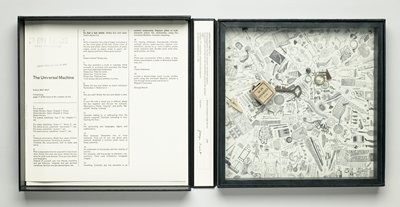
- Mixed media multiple consisting of glass, wood, metal, stone, plastic, and offset lithography on paper, housed in a black linen over board clamshell box
- Dimensions
- 11 1/8 x 11 1/8 x 1 1/2 in. (28.26 x 28.26 x 3.81 cm) (box, closed)
- Genre
- Multiples
Tags
United States
About
Named after the universal Turing machine (UTM), an early theoretical computing device invented by British mathematician Alan Turing (1912–1954), Brecht's Fluxus-infused Universal Machine playfully upends the logic-based systems of its predecessor by introducing the element of chance as the principal determinant of meaning. Brecht's machine consists of a black linen box containing a pane of glass, under which is a sheet of paper printed with collaged clip-art. Ten small objects of various materials rest upon the collage. Designed to be shaken so that the various objects randomly obscure portions of the printed images, the machine's output is interpreted according to a set of rules included along with the multiple. In an early interview, Brecht described the device's range of functions: It's a Universal Machine for doing everything. For writing a novel, making a poem, composing a piece of music, for finding lost objects. You can use it as a watch, as a calendar. It can invent new mathematics, a new form of thought. Map out an itinerary for a trip.