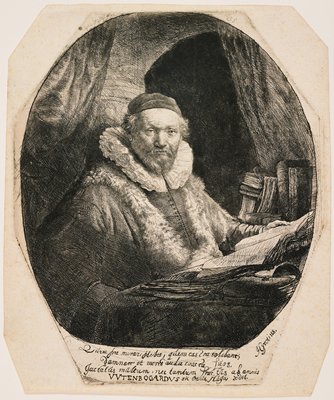
Jan Uytenbogaert, Preacher of the Remonstrants
- Medium
- Etching
- Dimensions
- 8 13/16 x 7 3/8 in. (22.38 x 18.73 cm) (plate, irregular) 9 3/16 x 7 3/4 in. (23.34 x 19.69 cm) (sheet, irregular)
- Genre
Tags
netherlands
About
In the early 17th century, the Dutch protestant community was fractious. Johannes Uytenbogaert (1557–1644) was a hero of the liberal Remonstrant faction of Calvinism, which argued that predestination was not absolute, and religious tolerance was ideal. His position led to his exile from Holland, from 1619 to 1626. The caption, written by Hugo de Groot—a Remonstrant still in exile in 1635—drew attention to Uytenbogaert's return to Holland. Rembrandt made both painted and etched portraits of Uytenbogaert, both probably commissioned by one of the Remonstrant's advocates. The irregular format of the printing plate, and the messiness of the inscription indicates this print was deeply personal, probably meant for close associates rather than general distribution.