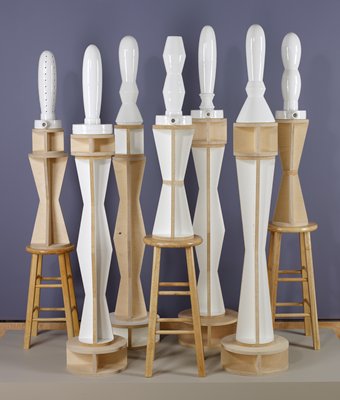
Morices
Yamada Tetsuya
2007
- Medium
- Ceramic, plywood, particle board, wood
- Dimensions
- 80 x 151 x 66 in. (203.2 x 383.54 x 167.64 cm) (installation)
- Genre
- Sculpture
Tags
United States
About
Tetsuya Yamada's accumulation of "Morice" sculptures stand together like so many attentive sentries. According to the early 20th century sculptor Constantin Brancusi, "Morices" were very special kinds of persons, "pure of heart and soul," who would recognize one another when they met. It is also the code name by which Brancusi and his close friend artist Marcel Duchamp addressed one another. Almost a century later, the artistic visions of Brancusi and Duchamp have been fused and memorialized by a young Japanese artist living in Minneapolis. Emerging initially from the craft traditions of Japan and America, Yamada combines his interest in conceptual art with his mastery of ceramics. In his "Morices," he mirrors the hand-hewn woodwork of Brancusi's sculptures with Duchamp's famous conceptual statement in porcelain, the iconic Fountain, 1917, a store-bought urinal that he insisted on exhibiting as art. Yamada fuses Brancusi's love of craft with Duchamp's rejection of it, paying homage to two extraordinary artists whose mutual respect but contradictory aesthetic views reflect fundamental divergences in twentieth century art.