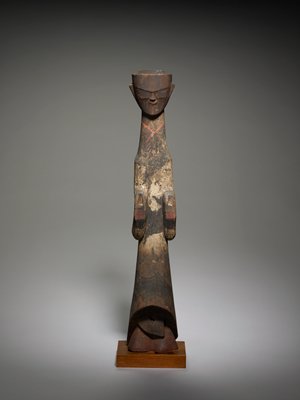
Figurine of a female court attendant
- Medium
- Wood with lacquer pigments
- Dimensions
- 23 1/4 x 4 3/16 x 4 5/8 in. (59.06 x 10.64 x 11.75 cm) (without mount)
- Genre
- Lacquer, sculpture
Tags
China
About
One of the most important styles of distinct regional lacquerware emerged during the Warring States period (475–221 BCE) in the southern state of Chu. Lacquered wooden human figures were placed in Chu tombs as substitutes for the sacrificial human victims of the early Bronze Age (c. 2000–1100 BCE), who were interred alive and made to serve and protect the deceased in the afterworld. These rare wooden tomb sculptures can be seen as forerunners of the more durable ceramic tomb figurines of people and animals for which the Han (206 BCE–220 CE) and Tang (618–907 CE) dynasties are famous (see examples in this gallery and in Gallery 207). Although stylized and simply cut, this statue’s long robe with deep sleeves, worn over trousers, is clearly depicted.