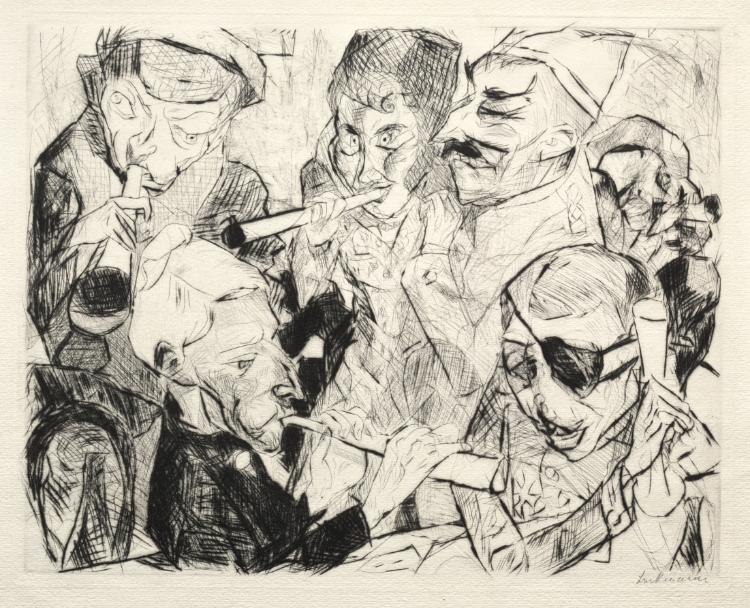
Hinter den Kulissen, from Jahrmarkt
Max Beckmann
1921
- Medium
- Drypoint
- Dimensions
- 13 3/16 x 18 1/2 in. (33.5 x 46.99 cm)
- Genre
Tags
Germany
About
In Jahrmarkt (Annual Fair), Max Beckmann imagines the world as a traveling carnival teeming with an eclectic cast of actors, dancers, and circus entertainers who perform in the theater of life. Beckmann casts himself as a carnival barker in the series’ opening plate, ringing a small bell to announce the show, and cajoling viewers to enter the Circus Beckmann, a curious realm of outsiders and misfits. Many of the protagonists are friends and acquaintances of the artist; he even includes his wife Minna in the series, who famously appears along with Beckmann balancing on a tightrope. As the scenes of the portfolio unfold, a pageant of players takes the stage: a tall man, a sharpshooter, a snake charmer, exotic dancers, musicians, and other circus entertainers perform in succession. In one plate from the series, Beckmann presents a carousal crowded with a diverse lot of humanity, an apt metaphor for the apparent aimlessness of life. The series was inspired in part by Beckmann’s visits to the Prater, a Viennese amusement park, where he observed the performers and visitors and sketched them from life. Justly celebrated for its incisive observations on the human condition, Jahrmarkt is a brilliant example of Beckmann’s mature graphic style and seminal publication of German Expressionism.
![Akrobat in der Brücke (Backbend) [p. 5]](https://api.nga.gov/iiif/2e88d686-95e8-4faf-bbd1-7996831a90ad/full/843,/0/default.jpg)
![Interieur mit Figuren (Figures in an Interior) [p. 25]](https://api.nga.gov/iiif/a716617f-cd66-4bcb-8d6b-d78a90e16cf3/full/843,/0/default.jpg)
![Fressender Löwe (Lion Eating) [p. 22]](https://api.nga.gov/iiif/58485433-97c6-4a1c-8f1b-74be8d6e4add/full/843,/0/default.jpg)
![Zwei ineinander verschlungene Ringkämpfer (Two Wrestlers Intertwined) [p. 25]](https://api.nga.gov/iiif/4f236a85-9420-4413-8050-3a84c93e0d99/full/843,/0/default.jpg)
![Gesicht (Face) [p. 86]](https://api.nga.gov/iiif/9abf4914-6aeb-4906-851a-8248fdd00369/full/843,/0/default.jpg)