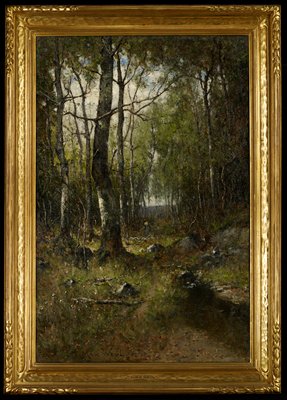
Temple Woods
Max Weyl
1882
- Medium
- Oil on canvas
- Dimensions
- 45 x 32 in. (114.3 x 81.28 cm) (outer frame)
- Genre
- Paintings
Tags
United States
About
Born in Muhlen-am-Neckar, Germany, Weyl began his working life as a watchmaker's apprentice. After immigrating to the United States, he set up shop in Washington, D.C. and in his off-hours began painting still-lifes. He finally gathered the courage to exhibit his paintings in his shop window in the early 1870s and soon they came to the notice of a customer, Samuel Kauffmann (publisher of the Evening Star and the president of the Board for the Corcoran Gallery of Art), who became a steady patron. Purchases by Mrs. Grover Cleveland and Mrs. Woodrow Wilson eventually placed the artist's works in the White House. Buoyed by the sale of his paintings, he went to Europe in 1879, where he came under the influence of the French Barbizon painters. He subsequently became know as the American Daubigny. Much of his subject matter centered on the environs of Washington, D.C., such as the Potomac River marshes and the Rock Creek Valley. The location of the present image, however, is not certain.