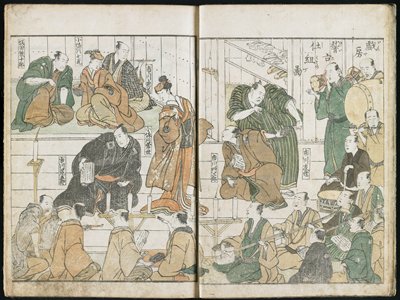
Picture Books of Amusements of Actors on all Three Floors (Gazu yakusha san-kai kyō)
Utagawa Toyokuni
1801
- Medium
- Woodblock printed book, ink and limited color on paper
- Dimensions
- 5/16 x 6 1/8 x 8 1/2 in. (0.8 x 15.5 x 21.6 cm)
- Genre
- Books & publications
Tags
Japan
About
By the mid-18th century, Kabuki had become a major cultural force. In Edo alone, there were four (later, three) theaters that offered lengthy programs nearly every day. While images of actors in their costumed roles dominated earlier print production, by the late 18th century a new genre of ukiyo-e emerged that showed them offstage, in more intimate settings. For this book, from a two-volume set, the artist Utagawa Toyokuni supplied compositions featuring famous actors. The title, Sankaikyō is a playful homonym of the name of a famous Buddhist sect, but also refers to the fact that typical dressing rooms in Kabuki theaters have three (san) floors (kai). This double page depicts such a dressing room.