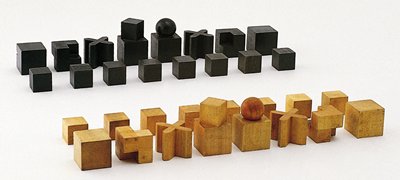
Set of 32 Chess Pieces
Josef Hartwig
1922
- Medium
- Wood and felt
- Dimensions
- 33.02 x 33.02 x 8.26 cm (13 x 13 x 3 1/4 in.)
Tags
german
About
Bauhaus artists and designers sought to revolutionize society by radically reshaping the environments in which people lived. The objects in this case, products of the school’s metal, pottery, and carpentry workshops, reflect innovative approaches to the design of everyday household items—from the minimalist rethinking of the ornate tea glasses of eastern Europe to the transformation of chess pieces into pure geometric form. The design of decorative art objects at the Bauhaus was as strongly informed by modern artistic theories as the paintings and sculpture produced there. The table lamp, for example, made in the metal workshop when the constructivist artist László Moholy-Nagy served as its director, explores the circular form in three dimensions: as a disk, cylinder, and sphere. Now considered an icon of Bauhaus design, in 1924 the lamp failed to achieve the Bauhaus goal of creating objects well suited for industrial production, due to its high fabrication cost. Relatively few Bauhaus objects were mass-produced, in fact, despite the school’s efforts to establish partnerships with industry. The objects’ extreme modernity and frequently high prices made them less appealing to the general public and relatively uncommon outside the homes of artists and intellectuals and the Bauhaus buildings.