The Planet Venus
Benvenuto Disertori
1923–1924
- Medium
- Etching
- Dimensions
- plate: 41 x 29 cm (16 1/8 x 11 7/16 in.)
- Genre
Tags
Italian
About
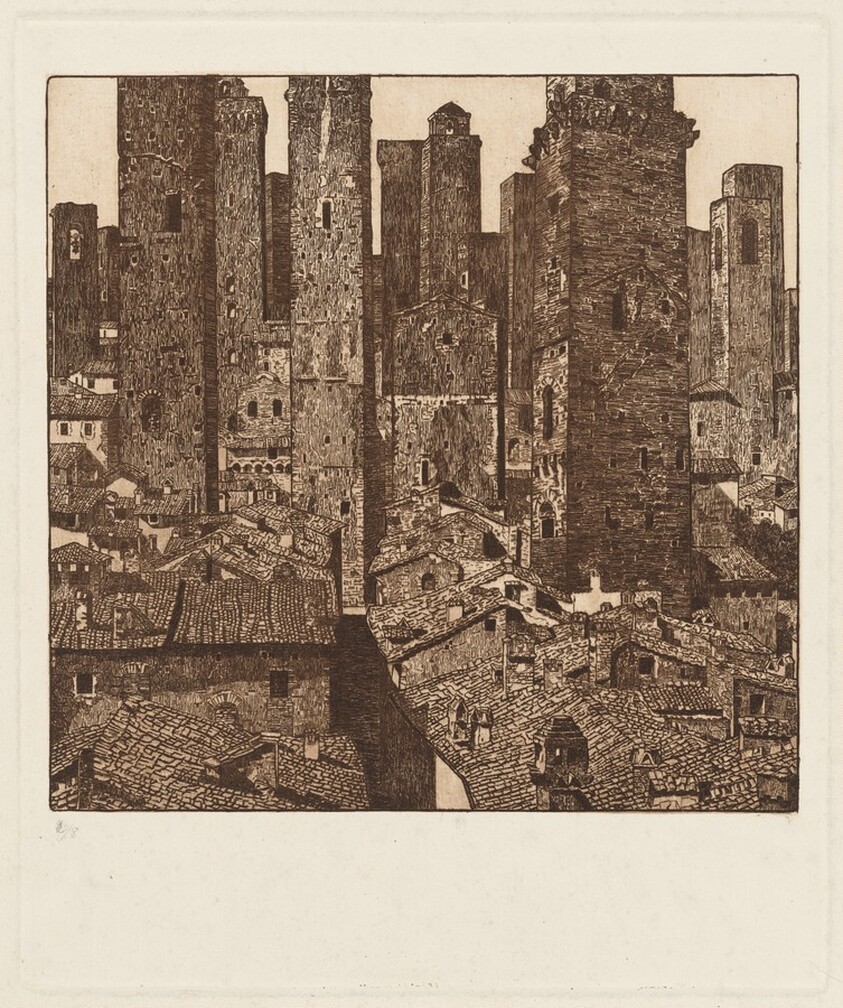
This is one of Disertori's most elaborate compositions, in an excellent proof impression prior to the completion of the inscription in the lower margin. It is one of three planet subjects, the others being Mars and Mercury, all with the same approximate composition. This is, however, the most engaging, with its view of S. Gimignano in the midst of an intramural war. The towers of the medieval city were supposed to have been constructed as acts of rivalry among its wealthy resident families, but the idea of siege engines, flaming barrages from catapults, and executed traitors seems to have been Disertori's fantasy. Were hostilities provoked by rape, adultery, and other acts of illicit love, sparked by the planetary goddess above? The inscription in a somewhat garbled Latin claims, however, that Venus will bring peace: "[as translated into Italian in the catalogue raisonne] Salve o Venere cacciatrice di bellezza, rinata in cielo dalla stella soave per portare pace nella bella città." Drawings survive that show that Disertori derived the siege engines and other instruments of war from several medieval visual sources, including the Paris 1483 edition of Valturio's "De re militari" and manuscripts in Italian archives. The archaism is characteristic: Disertori was also a great student of early music, and his personal collection of books, manuscripts, scores, and instruments is still preserved, in Il Fondo "Benvenuto Disertori" of the Biblioteca Nazionale Braidense, in Milan.