Cove at Sunset
Edward Mitchell Bannister
1880–1900
- Medium
- Oil on board
- Dimensions
- 27 × 32.8 cm (10 5/8 × 12 15/16 in.) framed: 31.5 × 37.8 cm (12 3/8 × 14 7/8 in.)
- Genre
- Paintings
Tags
American
About
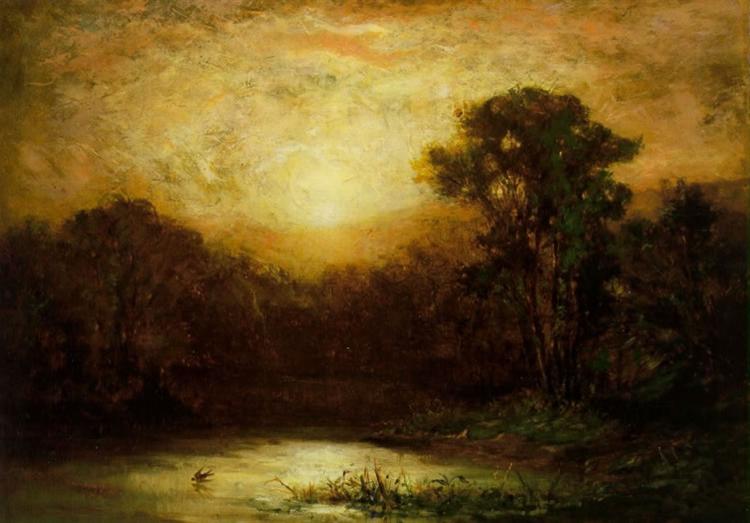
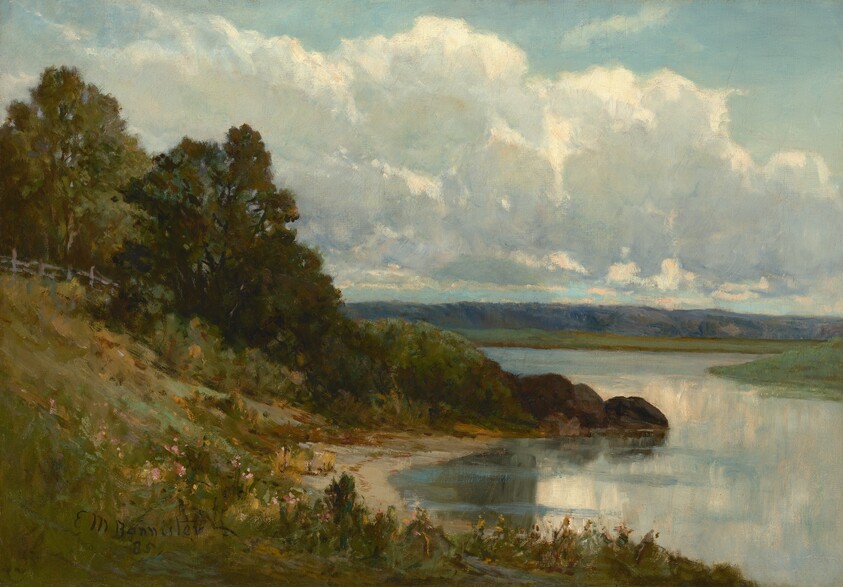
In the 1880s, Bannister built a small sloop he named the Fanchon (a play on “free” or “whimsy” in French). He spent weeks during the summer sailing the southern New England coast. From the foredeck and the shore, the artist sketched rocks and shifting plays of light on the water in graphite and oils. These studies became the basis of his teaching of plein air techniques at the Providence Art Club and foreground the larger, resolved com-positions he worked on during winter months.In this quintessential twilight study, Bannister adeptly balances color, line, and mass in the compact bands afforded by vertical delineations of water, earth, and sky. Though the Canadian-born, African American artist never traveled to Europe, his quick, varied brushstrokes, use of highly saturated colors, and penchant for littoral and pastoral scenes are in alignment with the approaches of the Barbizon School painters, such as Millet, Corot, and Daubigny.