The Procession of Saint Rosalia in Palermo
- Medium
- Watercolor, black ink, and graphite on off-white antique laid paper, laid down on wove paper, laid down on a matboard, framing line in black ink
- Dimensions
- 20.9 x 34 cm (8 1/4 x 13 3/8 in.)
- Genre
- Drawings
Tags
french
About
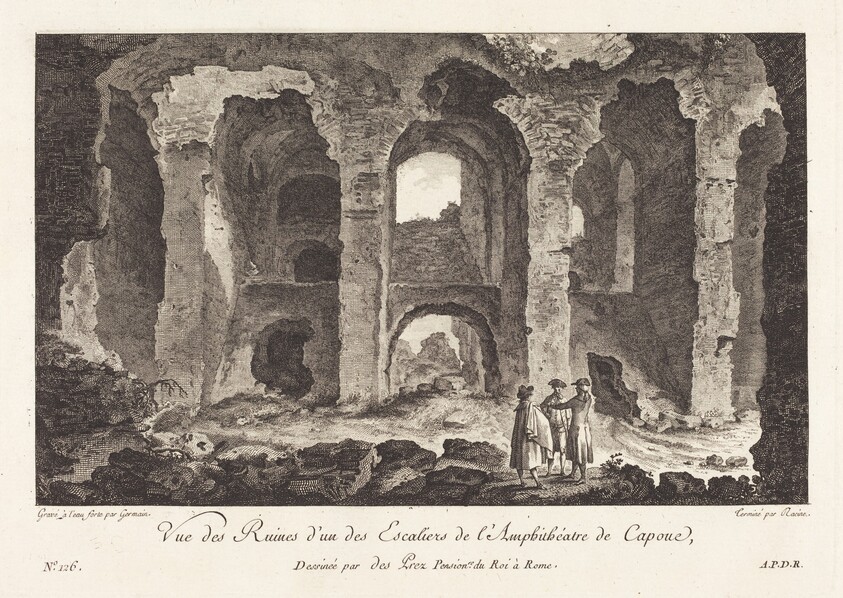
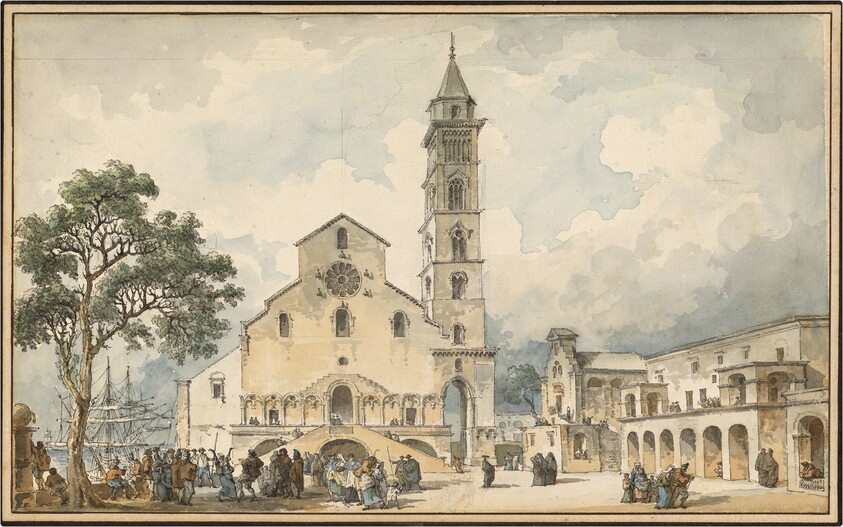
Best known for the spectacular theater and opera sets he designed in the 1780s and 1790s for the Swedish court, the painter and draftsman Louis-Jean Desprez established his career with drawings and watercolors produced for Abbé Richard de Saint-Non's "Voyages pittoresque: ou, Description des royaumes de Naples et de Sicilie" (Paris, 1781-86). A landmark in eighteenth-century book arts, the five-volume publication gave its name to the genre of often lavishly illustrated travelogues that appeared in its wake in Europe and Britain. Although rich in cultural traditions and artifacts, in the mid-eighteenth century Naples and Sicily remained off the route of most grand tourists. From 1759 to 1761, Saint-Non traveled in southern Italy with Jean-Honoré Fragonard and Hubert Robert, and it was on the basis of their drawings that he initially undertook to produce an illustrated account of the treasures of the region. In 1777, he commissioned additional drawings, most of them executed by Desprez and Claude-Louis Chatelet. Desprez traveled to Sicily in May 1778 with Dominique Vivant-Denon--the future museum director, then a secretary in the French diplomatic service in Naples--whom Saint-Non commissioned to produce a text. They arrived in Palermo in time for the annual celebration of the feast of St. Rosalia in July--the event recorded in this watercolor. It depicts the large, ornate cars (floats) that constituted the centerpiece of the procession, surrounded by dozens of attendants and spectators, before the twelfth-century cathedral. Smoke from celebratory cannon-fire hangs over the crowd. The work displays Desprez's virtuosity at its best: the architecture and innumerable small figures rendered in minute detail, the smoke and clouds in a looser technique, and the teeming festivity recorded with a scenographic flair that predicts the artist's achievement as a designer of stage spectacles. In the event, this view of the procession of St. Rosalia was not engraved for reproduction in the "Voyage pittoresque." Like many other Desprez watercolors of Naples and Sicily, this painstakingly wrought, pictorially finished composition was clearly intended as an independent work of art. A squared, ink-and-wash drawing of the cathedral and the empty piazza (Sweden, private collection) evidently served as a preparatory study for our watercolor.