Every Building on the Sunset Strip
Edward Ruscha
1966
- Medium
- Photolithograph
- Dimensions
- book closed: 18.2 x 14.4 x 1 cm (7 3/16 x 5 11/16 x 3/8 in.) slip case: 18.5 x 15 x 1.5 cm (7 5/16 x 5 7/8 x 9/16 in.) open (H x W x D): 7.6 x 162.6 x 14.4 cm (3 x 64 x 5 11/16 in.)
- Genre
Tags
American
About
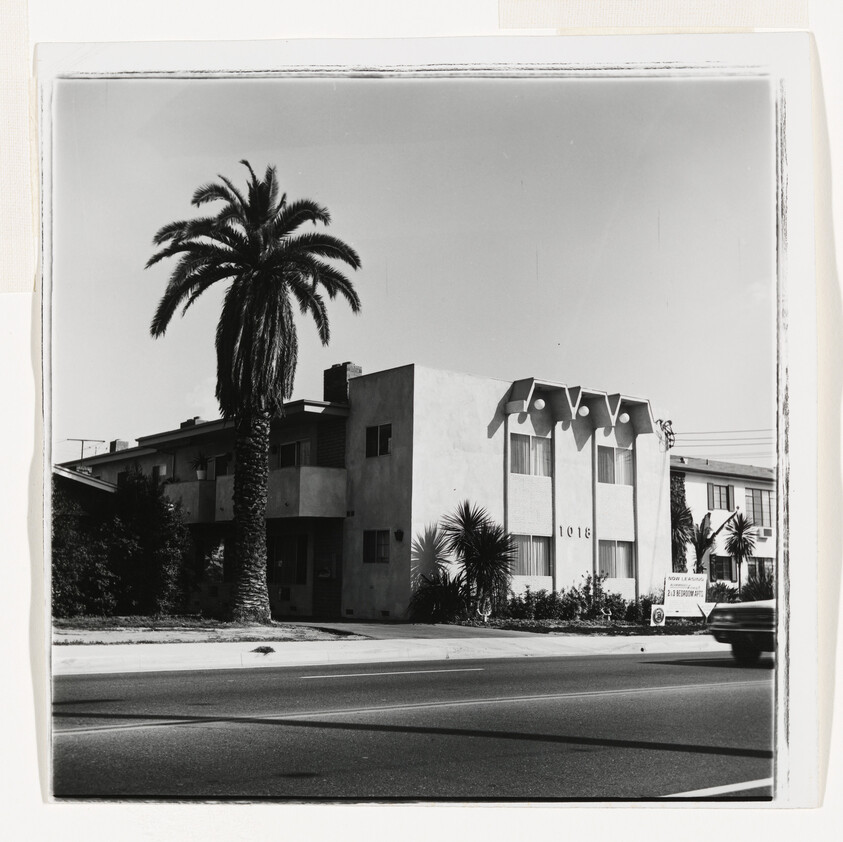
On a Sunday morning, Ruscha loaded an automatic camera, looped around every building on the Sunset Strip to expose one mile of night-life fame in broad daylight, and accordion-folded it in book. Now unfold the vice versa panorama and a flnerie-on-wheels immediately begins to stretch out left and right, upon and down the boulevard, but so smooth and silent and straight is the sliding ride over the luster of the printed page that the caressing eye irons out any possible photographic depth in the scenography of Los Angeles. To sweep the Strip further would only wear its legend even thinner. Ruscha's photo-books were a complete anomaly in the art scene of sixties. They later became a brand name once they have been situated by critics and historians in relation to Marcel Duchamp's ready-made and Andy Warhol's serial reproduction techniques (both artists had their first American exhibit, in Los Angeles, in 1962 when Ruscha published his initial Twenty-Six Gasoline Stations) as well as the aestheticizing of everyday architecture with Robert Venturi's 1972 Learning from Las Vegas. They also troubled the conventions of artist's books by using offset printing to develop "a mass-production of a higher order," and more importantly, freed the double-bind between book and photograph in which one was either the commentary, or the illustration of the other.
![[A Few Palm Trees Contact Sheet]](https://whitneymedia.org/assets/artwork/23654/2004_580_cropped.jpg)
![[A Few Palm Trees Contact Sheet]](https://whitneymedia.org/assets/artwork/23651/2004_577_cropped.jpg)