Nydia, the Blind Flower Girl of Pompeii
Randolph Rogers
1859
- Medium
- Carved
- Dimensions
- 91.4 x 61 x 48.3 cm (36 x 24 x 19 in.) 290 lb.
- Genre
- Sculpture
Tags
American
About
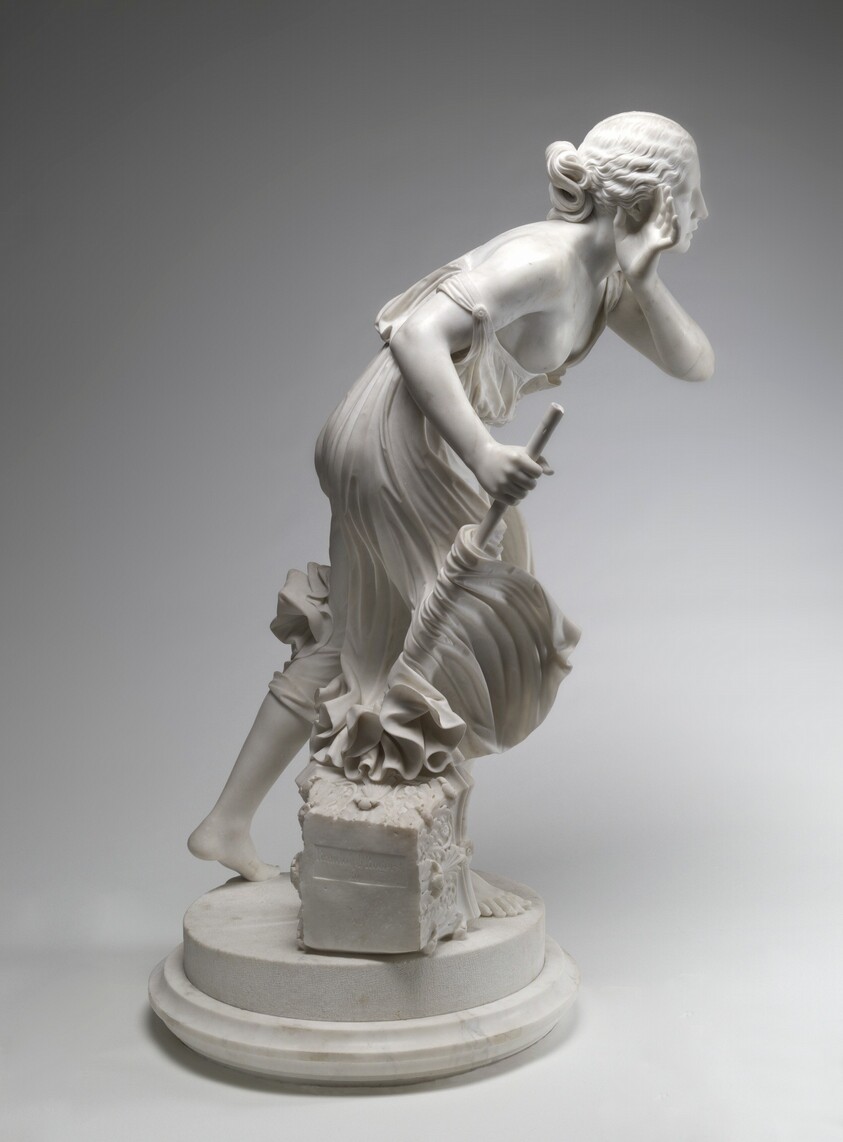
This captivating sculpture depicts the heroine of Edward Bulwer-Lytton’s historical novel "The Last Days of Pompeii" (1834). Nydia is a blind, enslaved flower-seller liberated by a nobleman named Glaucus. During the eruption of Mount Vesuvius, Nydia risks her life to save Glaucus and his fiancée. Rogers portrays Nydia navigating the city amid the ecological upheaval of the eruption. The dynamism of her tunic, the broken Corinthian capital at her feet, and her hunched form convey her forward momentum against the high winds, ash, stone, and debris she must traverse. The elegance of Nydia’s arm crossing her body to cup her hand at the ear lends balance to the asymmetrical form while alluding to Nydia’s acute sense of hearing. In the 1850s, the abolitionist movement and the excavations at Herculaneum, Paestum, and Pompeii reinvigorated public interest in the novel. Rogers’s studio sold 167 copies of Nydia in two different sizes.