Proun 12E
El Lissitzky
1923
- Medium
- Oil on canvas
- Dimensions
- 57.2 x 42.5 cm (22 1/2 x 16 3/4 in.) framed: 62 x 46.5 x 4.3 cm (24 7/16 x 18 5/16 x 1 11/16 in.)
- Genre
- Paintings
Tags
russian
About
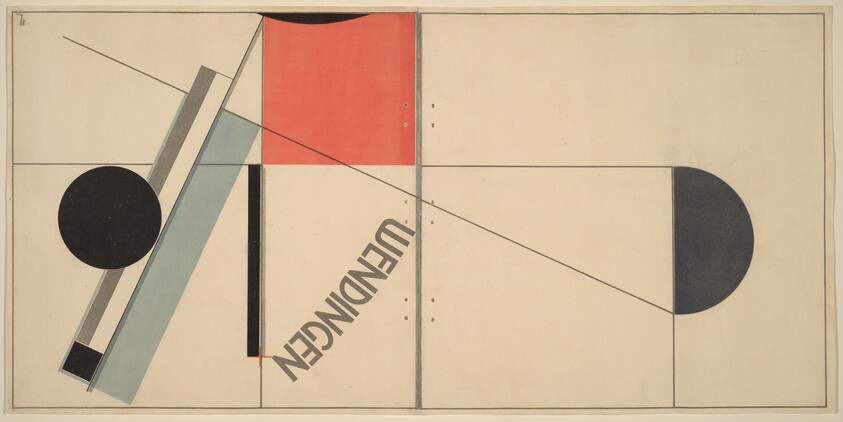
While other constructivist artists in postrevolutionary Russia abandoned easel painting in favor of utilitarian forms such as photography, film, and graphic design that were believed to more easily serve the new state, Lissitzky asserted painting’s important role in advancing creative and spiritual life. His compositions, which he named Prouns (an acronym for the Russian phrase “project for the affirmation of the new”), broke with traditional painterly conventions, and fed “on the ground fertilized by the dead bodies of pictures and their painters.” Proun 12E is typical of Lissitzky’s new pictorial language. A wide band extends across the width of the canvas, anchoring a variety of geometric forms that hover above, defying laws of gravity and perspectival logic. The floating construction that hinges on a red sphere seems to project into space instead of receding into it, as it would in traditional painting. Prouns provided the springboard for Lissitzky’s later artistic activities in diverse fields such as typography and architecture.



![[title page]](https://media.tate.org.uk/art/images/work/P/P07/P07137_10.jpg)

