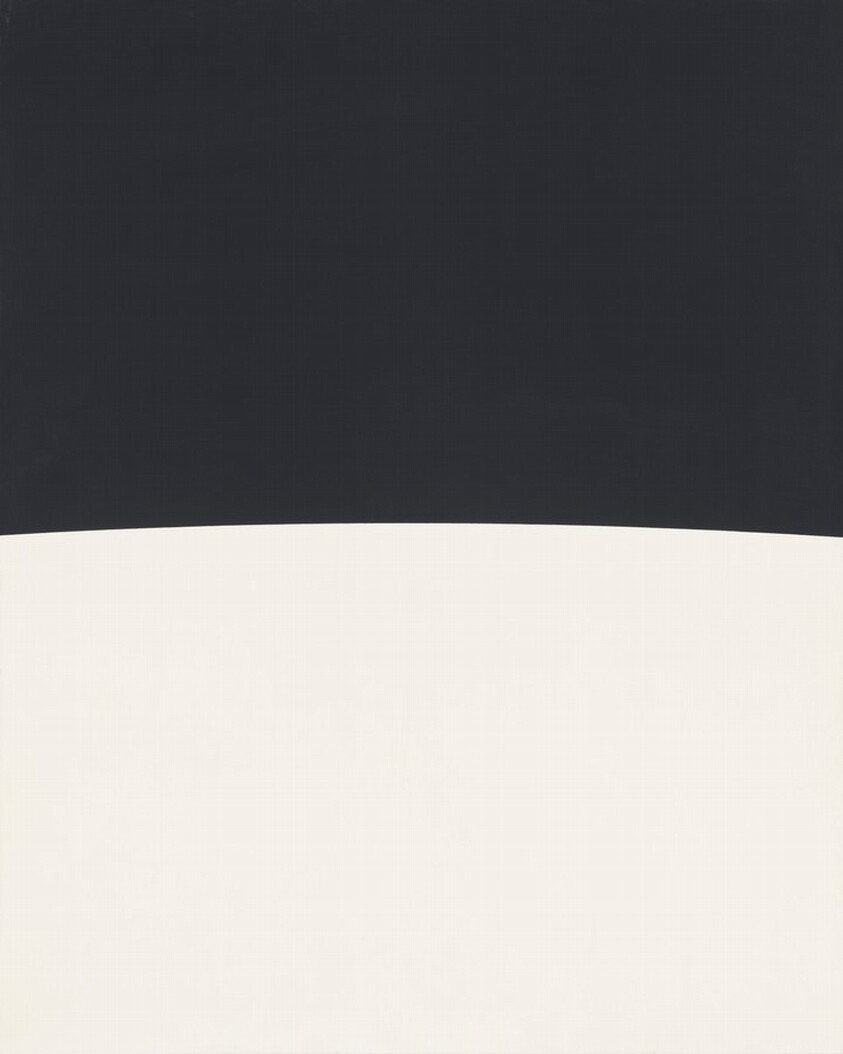
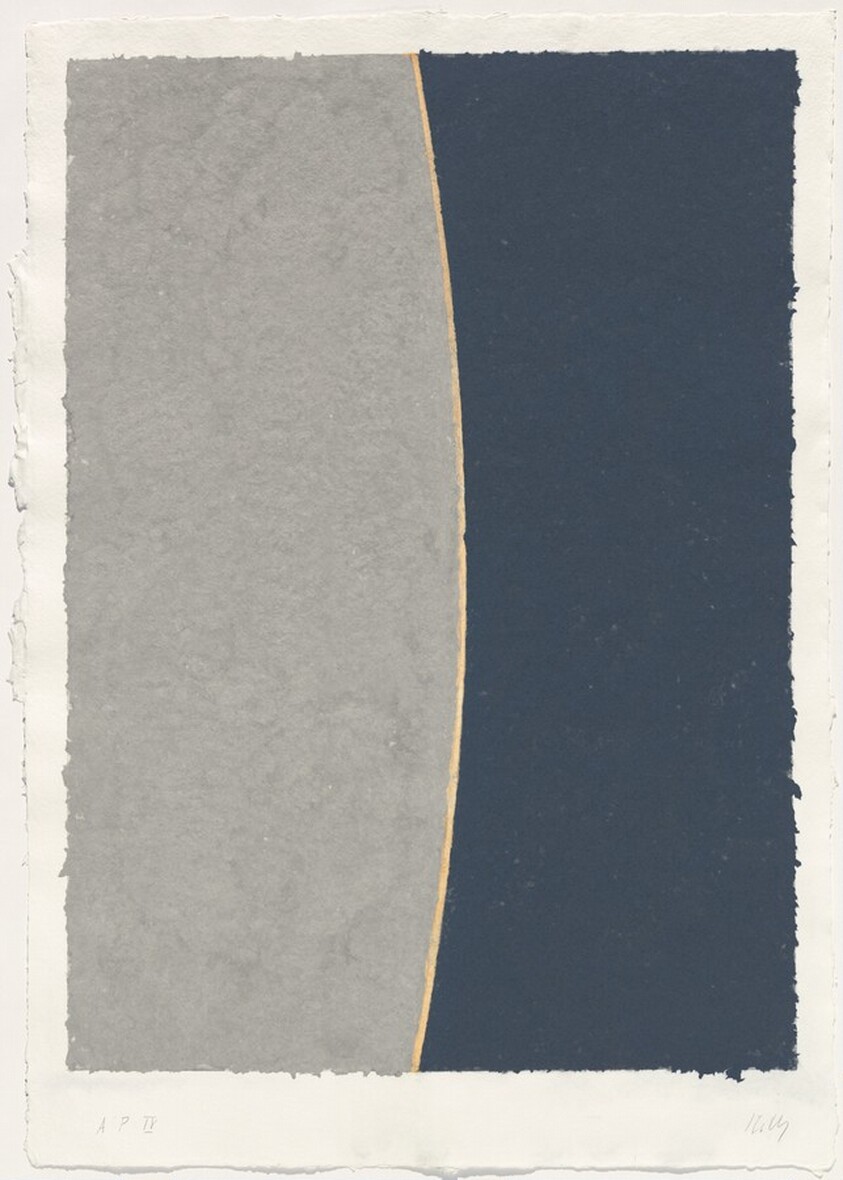
Sketch of a Beach Cabana III
Ellsworth Kelly
1950
- Medium
- Graphite on cream wove paper
- Dimensions
- 27 x 21 cm (10 5/8 x 8 1/4 in.)
- Genre
- Drawings
Tags
American
About
Ellsworth Kelly's works on paper from the late 1940s to the early 1950s played a seminal role in the development of his art. Executed in France, where he lived from 1948 to 1954, the five drawings under gift and purchase consideration are crucial works in Kelly's development of a highly individualized and radically original strategy for making his art. The four beach-cabana drawings are clear examples of Kelly deriving abstract form from observed reality and chance encounter. While spending time at the beach at Meschers, a resort on the Atlantic coast of France, Kelly took a number of photographs and made six elaborate sketches of beach cabanas. Recorded in deadpan style, shown frontally and parallel to the picture plane, the drawings reveal how Kelly's attention was drawn not to the striped design of the cabana fabric but to the random motif of the many patched repairs that by chance upset the orderliness of the of the pattern. As Kelly later noted: "Everywhere I looked, everything I saw became something to be made, and it had to be exactly as it was, with nothing added. It was a new freedom: there was no longer the need to compose. The subject was there already made, and I could take from everything. It all belonged to me: a glass roof of a factory with its broken and patched panels, lines on a road map..., paper fragments in the street. It was all the same: anything goes." [1] Although the world around Kelly became a sourcebook of ready-made compositions, his transfer or translation of the original referent was always distilled and recast in an entirely abstract idiom. He was never concerned with conveying any memory or metaphoric connotation of the original motif, focusing instead on the pictorial and entirely abstract concerns that have preoccupied him in both his sculpture and painting to this day. In 1951, the transfer process begins to fade from Kelly's work and a new focus on the structure of the grid and a emphasis on color come to the fore. This shift seems to have been precipitated by two events. First, Kelly, who was teaching at the American School in Paris, had a dream which he sketched upon awakening. Kelly recalled how in the dream he "was working on a scaffold with a lot of children, creating an immense mural composed of square panels..." [2] In response, Kelly cut up an existing drawing into little squares which he then randomly arranged in a grid and glued onto a fresh sheet of paper. Second, the artist discovered papier gommette, the brightly colored gummed paper used in French kindergartens. Initially, he used tiny squares of the gummed paper in eight large and vibrant collages, all based on a modular grid, the series entitled "Spectrum Colors Arranged by Chance." Whereas some of the Spectrum collages have as many as 1600 pieces of the paper glued down, in his subsequent work, Kelly dramatically enlarged the size of the color units into long bands and then finally, as in the "Nine Colors" series, divided the units into separate color panels. "Nine Colors on White I" from 1953, is the first of a large series of these pared down drawings based on just nine color blocks and conceived with a multipanel work in mind. Through the reworking of the basic arrangement of the color blocks, Kelly explored numerous possible configurations and permutations, the only constants among the collages being the color arrangement and the sense of color and surface fused as one. 1: Kelly, "Notes from 1969," in "Ellsworth Kelly: Painting and Sculpture 1966-1979" (London: British Arts Council, 1979) as quoted in Yve-Alain Bois, "Kelly's Trouvailles: Findings in France, " in "Ellsworth Kelly: The Early Drawings, 1948-1955" (Cambridge: Harvard University Art Museums, 1999), p. 20. 2: Kelly, quoted in Harry Cooper," Ellsworth Kelly: The Early Drawings 1948-1955," (Harvard University Art Museums, 1999, exhibiton guide), n.p.