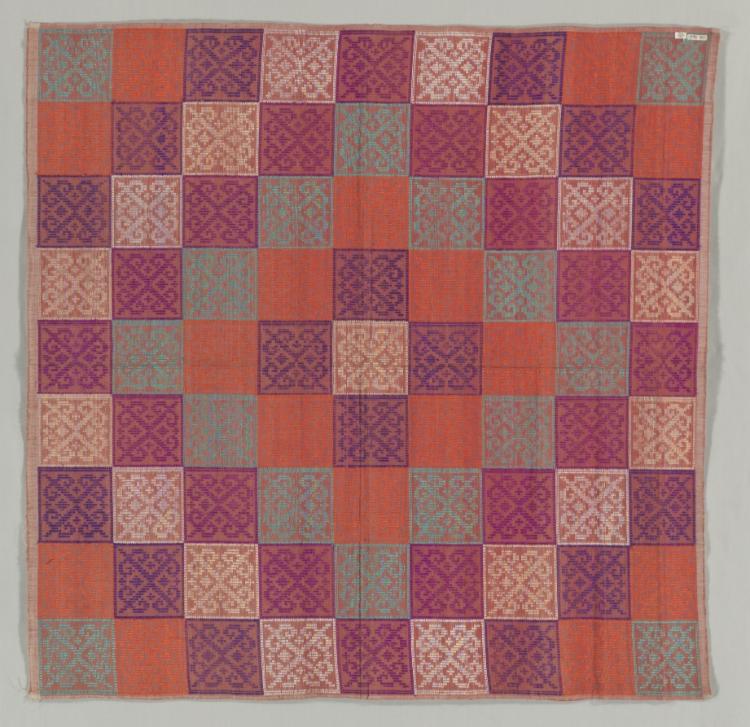
Headcloth (Yakan seputangan)
1900–1917
- Medium
- plain weave with paired weft: cotton; supplementary weft: silk
- Dimensions
- Overall: 97.5 x 95 cm (38 3/8 x 37 3/8 in.)
- Genre
- Garment
- Museum
- Cleveland Museum of Art
Styles
Tags
Philippines
About
This seputangan (headcloth) was produced by the Yakan people of Basilan, and worn by men in ceremonial, formal, and dress contexts. The cloth was woven on a back-strap loom with a cotton warp and patterned using supplementary-weft silk, which produces the characteristic lustrous motifs across the surface. The vivid, high-contrast color combinations are characteristic of Yakan ceremonial textiles.