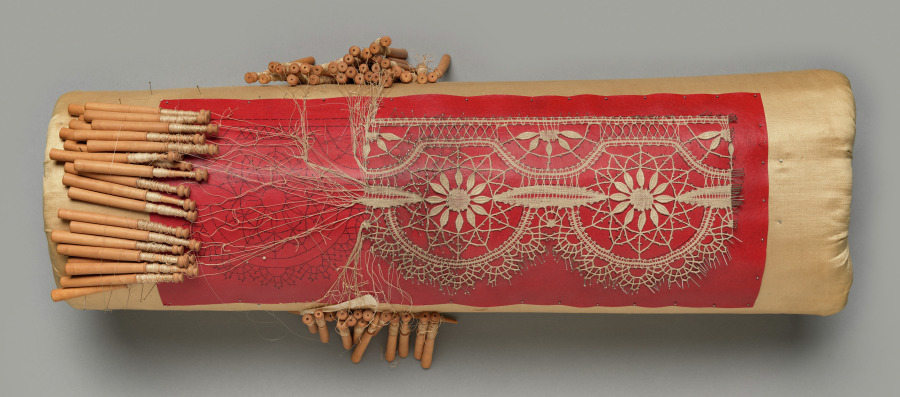
Torchon Bobbin Lace Pillow
1800–1899
- Medium
- lace, bobbin
- Dimensions
- Overall: 18.5 x 72.5 x 24 cm (7 5/16 x 28 9/16 x 9 7/16 in.)
- Genre
- Lace
- Museum
- Cleveland Museum of Art
Styles
Tags
Spain
About
Spanish bobbin lace is made on a cylindrical straw-stuffed bolster pillow of a size and shape like this one. Further evidence of a Spanish origin is the shape and materials of the handmade bobbins (boxwood in this case). The lace maker would have sat with one short end of the pillow (the end with the bobbins) in her lap and the other end propped against a table. A pattern (pricking) on red card stock is pinned to the pillow around the perimeter. Linen thread is wound on the boxwood bobbins. To create this Torchon lace edging, the thread on the bobbins is crossed and twisted to create a connection. A pin is then placed in the pillow to correctly space each connection. Once complete, the pins are removed, and the bobbin lace separated from the pillow. The 15.2 cm (6-inch) wide piece of Torchon lace edging created on this pillow is a common type of lace, easy and fast to make. It has leaf-shaped tallies. The foot side (straight edge) of the Torchon lace edging on this pillow would have been sewn to the edge of a garment or a furnishing fabric. The scalloped edge is referred to as the headside of this Torchon lace.