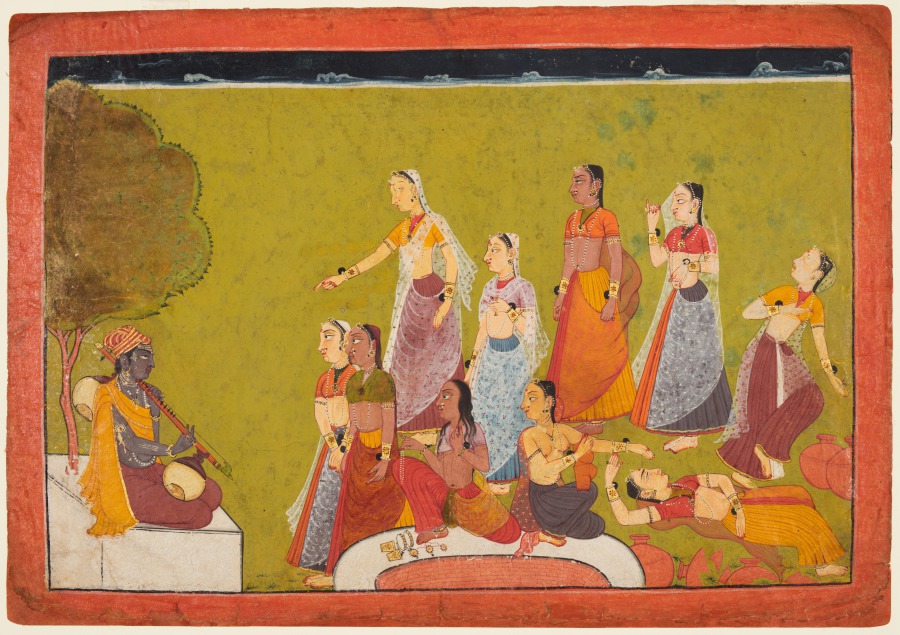
A group of women in ecstasy before Madhava, folio 4 from a Madhavanala-Kamakandala
1715–1725
- Medium
- gum tempera and gold on paper
- Dimensions
- Page: 21.7 x 31 cm (8 9/16 x 12 3/16 in.); Image: 19.1 x 28.3 cm (7 1/2 x 11 1/8 in.)
- Genre
- Paintings
- Museum
- Cleveland Museum of Art
Tags
Northern India, Pahari kingdoms
About
The raptures of Madhava’s audience intensify. As he plays, the music becomes increasingly climactic. Several women stand immobilized; others make emotive gestures. Some faint, while others feel compelled to remove their clothes and jewelry. Written by a Sufi Muslim poet embracing mysticism, the story shows how devotees should feel toward Allah, god of Islam. In the Hindu courts of Pahari India, however, the story provided entertainment for the educated elite. The women’s ecstasies can also be viewed in the context of the Hindu devotional movement (bhakti), characterized by using poetry and art to stir a sense of erotic love for Krishna or Rama.