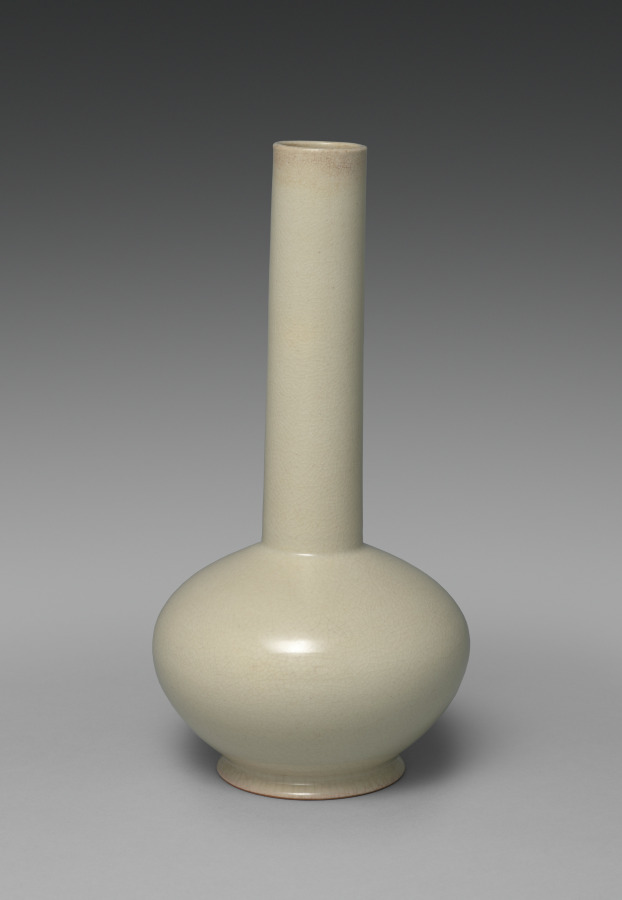
Long-Necked Vase
Seifu Yohei III
1893–1897
- Medium
- Stoneware with crackled glaze
- Dimensions
- height: 30 cm (11 13/16 in.); Diameter: 15.5 cm (6 1/8 in.)
- Genre
- Ceramics
- Museum
- Cleveland Museum of Art
Styles
Tags
Japan, Meiji period (1868–1912)
About
The glazing of this long, narrow-necked and bulbous-based vase has a network of shallow cracks, created when the glaze fractured as it cooled from firing. It is called a cracked-ice pattern or glaze, since the effect resembles the surface of a frozen lake. The cracks here are of a consistently high density throughout the vessel. This pattern is observed also in the transparent glaze of some Kyoto ware, in some of Yohei III’s green glazes, and in some of his vessels emulating Chinese forms. The interior of the box lid has an attestation to its authenticity by Yohei IV, and the footring is inscribed Seifū of Great Japan (Dai Nihon Seifū) in iron black.