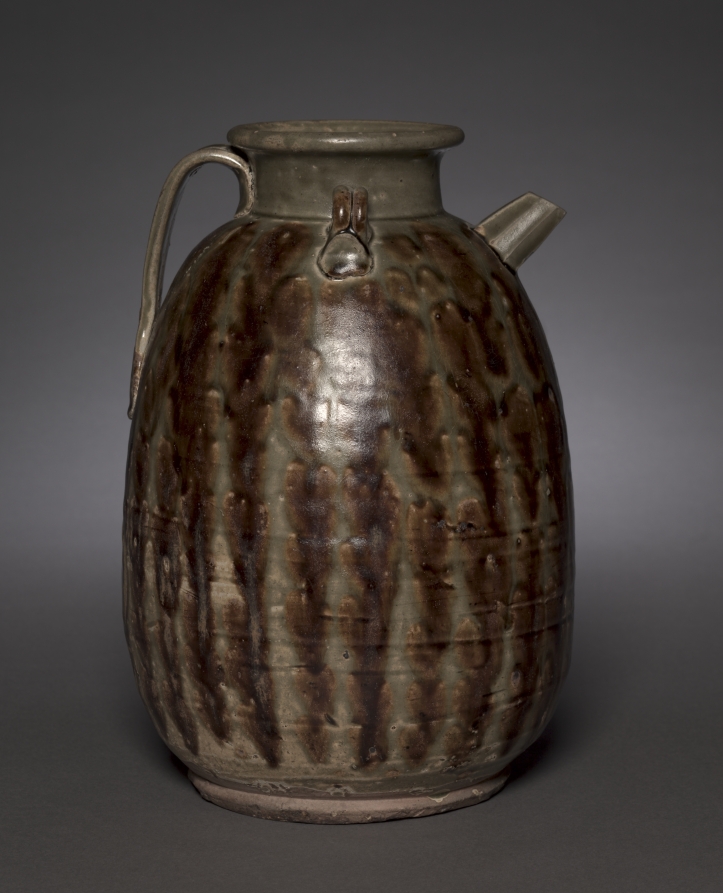
Ewer
800–899
- Medium
- stoneware with olive-green glaze and ironbrown splashes, Changsha ware
- Dimensions
- Overall: 29.2 x 19.8 cm (11 1/2 x 7 13/16 in.); Diameter of rim: 10.3 cm (4 1/16 in.)
- Genre
- Ceramics
- Museum
- Cleveland Museum of Art
Styles
About
Used originally as a tea or wine ewer, this vessel has the strength of a Tang ceramic shape and the typical characteristics of Changsha ware, such as the stout proportions, the short, polygonal spout, and an overall color harmony and bold decoration. Its exterior is decorated with an olive-green glaze with iron-brown spots. The brown and the green glazes run into each other at certain areas during firing, creating a distinctive splashed-color effect. A more laborious treatment of the surface decoration makes this piece a rarity among surviving Changsha specimens. Changsha ware was a line of popular ware widely used and distributed within China. Specimens have been excavated not only in Hunan province, the area of production, but also in Shaanxi, Henan, Hebei, Hubei, Anhui, Jiangsu, Guangdong, and Guangxi provinces. As valuable export commodities of Tang dynasty China, Changsha wares have also been found at ancient sites in Japan, Korea, the Philippines, Thailand, Indonesia, Pakistan, Sri Lanka, Iran, Iraq, Arabic Peninsula, and Egypt.