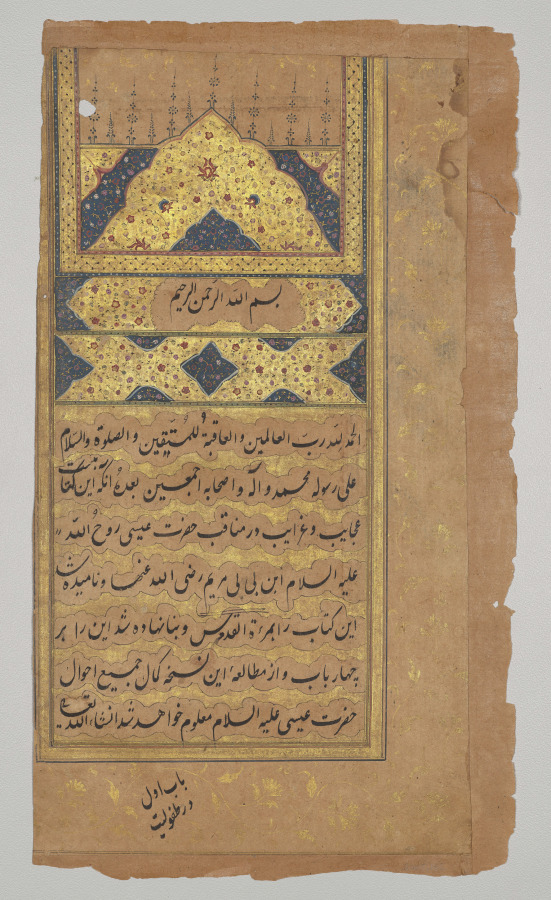
Illuminated opening page (folio 1 verso) and 131 folios with Persian text, from a Mirror of Holiness (Mir’at al-quds) of Father Jerome Xavier
1602–1900
- Medium
- Gum tempera, ink, and gold on paper
- Dimensions
- Page: 26.1 x 15.4 cm (10 1/4 x 6 1/16 in.)
- Genre
- Manuscripts
- Museum
- Cleveland Museum of Art
Tags
Mughal India, Allahabad, made for Prince Salim (1569–1627)
About
The opening page of this Christian manuscript is ornamented in the manner of books made for elite Islamic patrons. Using costly pigments made from the semiprecious blue stone called lapis lazuli and gold paint, the artists created contrasting ground colors to set off delicate floral arabesques that evoke the waters and light of paradise. The text was written in Persian, the official court language of the Mughal rulers in India, and read from right to left. Father Jerome had studied Persian in India for seven to eight years before Akbar asked him to produce a history of the life of Jesus in Persian.