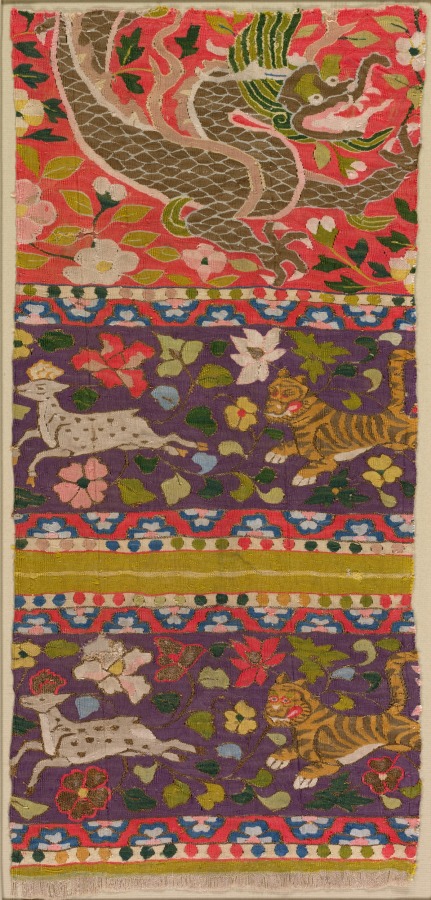
Tigers Chasing Deer, with Dragon
1000–1199
- Medium
- Silk and gold thread; tapestry
- Dimensions
- Overall: 58 x 27.2 cm (22 13/16 x 10 11/16 in.); Mounted: 75.6 x 43.8 cm (29 3/4 x 17 1/4 in.)
- Genre
- Textiles
- Museum
- Cleveland Museum of Art
Styles
About
This reversible tapestry (kesi) fragment woven with silk and metal thread is a section from yardage likely intended for a garment, but no contemporary paintings exist to confirm this. The starting, bottom edge of the textile is preserved which indicates the bands at the base would have been the cuff ends of a garment. The design motifs of this kesi—a dragon at the top, bands of pearls and split palmettes, and tigers chasing deer with mushroom-shaped antlers—are a synthesis of Western and Chinese elements. The pearls, palmettes, and deer motifs originated in Iran and Sogdiana (an area east of the Caspian Sea and northwest of the Himalayas) but migrated east to China during the Tang dynasty (618–907). Although these motifs disappeared from Chinese art after the fall of the Tang, they survived in Central Asia. In contrast, the dragon is Chinese in origin, but here has a Central Asian form (particularly its extended snout).