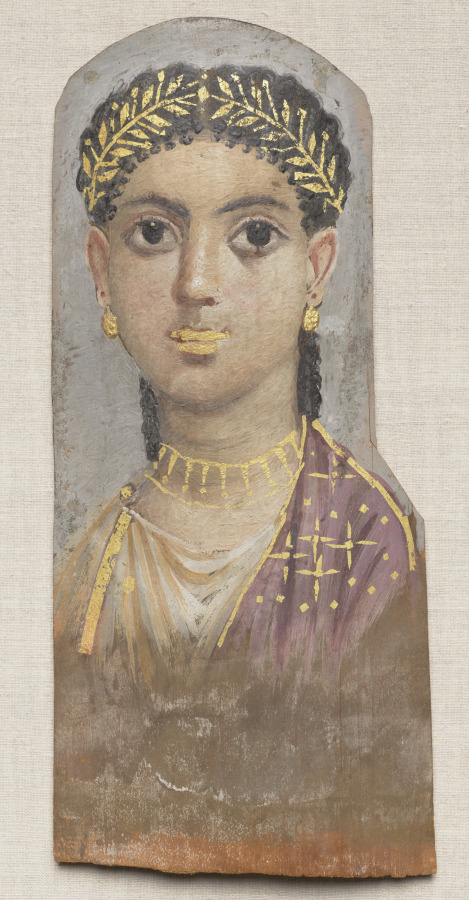
Funerary Portrait of a Young Girl
25–37
- Medium
- encaustic on linden wood
- Dimensions
- Overall: 39.4 x 17.4 cm (15 1/2 x 6 7/8 in.)
- Genre
- Paintings
- Museum
- Cleveland Museum of Art
About
Transforming the spirit—not beautifying the mortal body—may have been the purpose of adding golden lips and jewelry to this painting. Egyptian-style burial customs and arts persisted throughout Greek, Roman, and Byzantine rule over Egypt (305 BCE–641 CE). The woman depicted in this panel lived between cultures. Her or her family’s choice of mummification reflected historical Egyptian practices of creating a physical “duplicate” for the deceased’s soul to rest in, and their decision to color her lips gold here may symbolize how death transformed her into an akh (effective spirit). In contrast, the choice of her clothing and hairstyle showed her embrace of contemporary ideals of Hellenic (Greco-Roman) Egyptian identity.