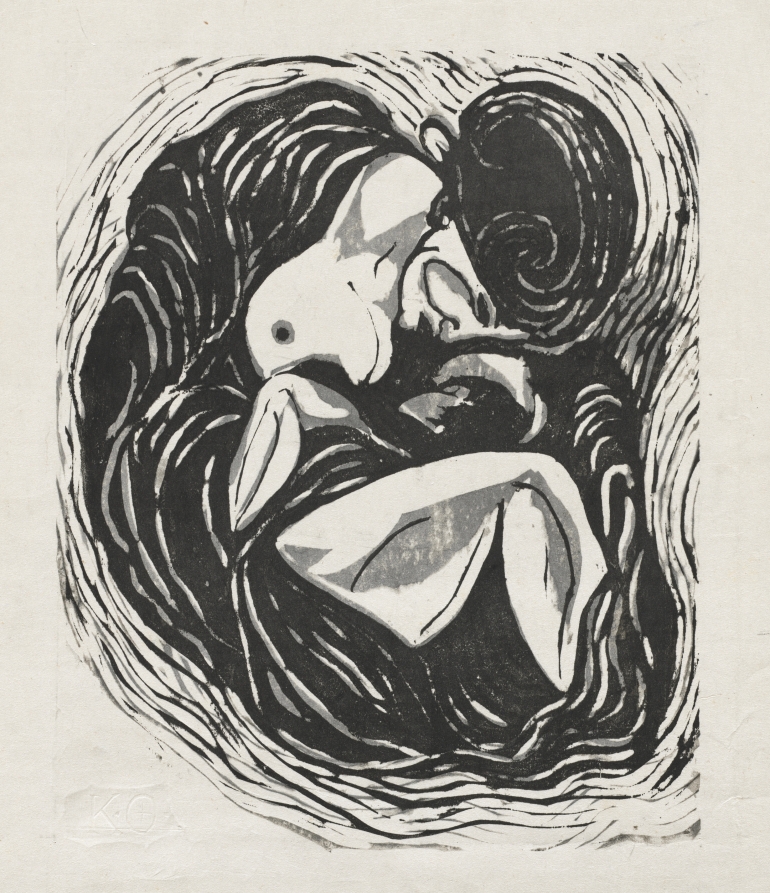
Mother and Child
Koshiro Onchi
1915–1955
- Medium
- woodcut
- Genre
- Museum
- Cleveland Museum of Art
Styles
Tags
Japan
About
Kōshirō Onchi was a key figure in the sōsaku-hanga movement. He not only provided essential aesthetic and spiritual leadership, but his aristocratic background made him a forceful advocate of printmaking within the hostile bureaucracy of Japan's hierarchical art world. Onchi admired the nonobjective images of Russian artist Wassily Kandinsky and the Expressionist style of the Norwegian artist Edvard Munch, whose works shared a kinship with his own interests in the expressive power of nonrepresentational and abstracted figural compositions as well as color. Onchi was particularly attracted to the medium of woodcut in which he felt he was forced to simplify his forms and thus intensify the expression of his emotion while cutting, gouging, and scraping the image into the block.