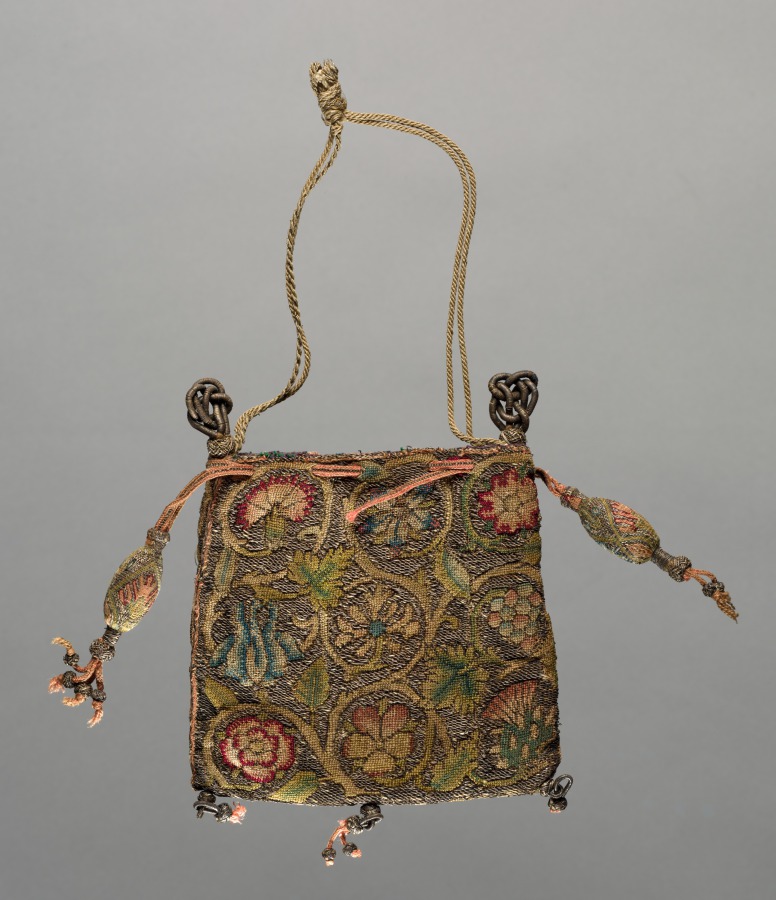
Purse
1600–1620
- Medium
- embroidery; silk and silver filé on linen ground
- Dimensions
- Overall: 11.5 x 12 cm (4 1/2 x 4 3/4 in.)
- Genre
- Embroidery
- Museum
- Cleveland Museum of Art
Styles
Tags
England, early 17th century
About
According to Elizabethan embroidery scholar Jacqui Carey, the scale and construction of this purse and its trimmings are typical of a so-called ‘sweet bag’, a container for sweet-smelling substances. This term was popularized in George Wingfield Digby’s 1963 publication on Elizabethan embroidery; Digby used the term to describe small English purses dating from the 1500s and 1600s. In CMA’s example, the handle and lining look to be later replacements. The embroidery is worked on an open plain weave linen fabric with silk in a range of colors and silver metal thread (thin metallic strips wrapped around a white silk core). In places, the inked design is visible on the linen. The stitches used for the purse’s background are unusual in that they lie horizontally rather than vertically. The rectangle of embroidered fabric was folded along the base and stitched together up the sides. Ten holes are pierced through the embroidered fabric near the top edge of the purse. Two drawstrings, terminating in ornate tassels, are threaded through the holes. The nine floral motifs-- carnation, borage, rose, columbine, honeysuckle, grapes, rose, pansy and thistle—set within coiling stems and foliage are typical of the period. Two embroidery stitches were used, tent stitch and Elizabethan ground stitch.