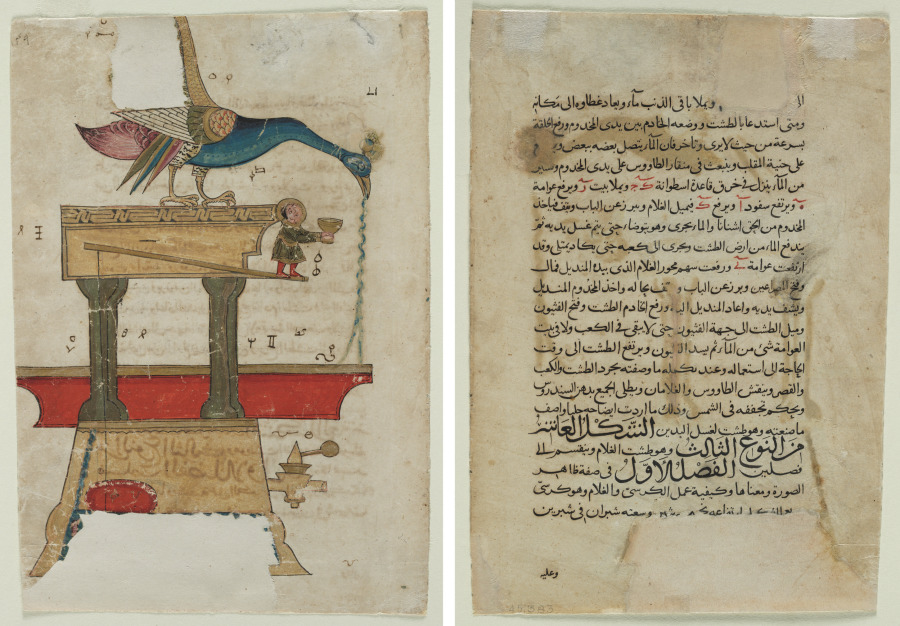
Peacock-shaped Hand Washing Device (recto); Text Page, Arabic Prose (verso)
1315
- Medium
- opaque watercolor and gold on paper
- Dimensions
- Overall: 31.3 x 21.5 cm (12 5/16 x 8 7/16 in.)
- Genre
- Manuscripts
- Museum
- Cleveland Museum of Art
Tags
Syria, Damascus, Mamluk Period, 14th Century
About
This leaf from a 1315 Syrian copy of Ibn al-Razzāz al-Jazarī’s The Book of Knowledge of Ingenious Mechanical Devices, written in 1206, depicts a peacock basin automaton for ritual hand washing. There are 15 surviving manuscript copies of al-Jazarī’s work, ranging from the early 13th to the late 19th century. An engineer from upper Mesopotamia, al-Jazarī was in the service of King Nasrī al-Dīn when he completed his masterwork, an anthology of automated devices including clocks, trick vessels for drinking sessions, devices for washing, fountains, water-raising machines, and measuring instruments. His designs clearly illustrate that automata were not innovations from Western Europe, but they stemmed from a tradition known in the ancient, Islamic, and Byzantine worlds. We do not know with certainty that al-Jazarī’s device was ever actually constructed.